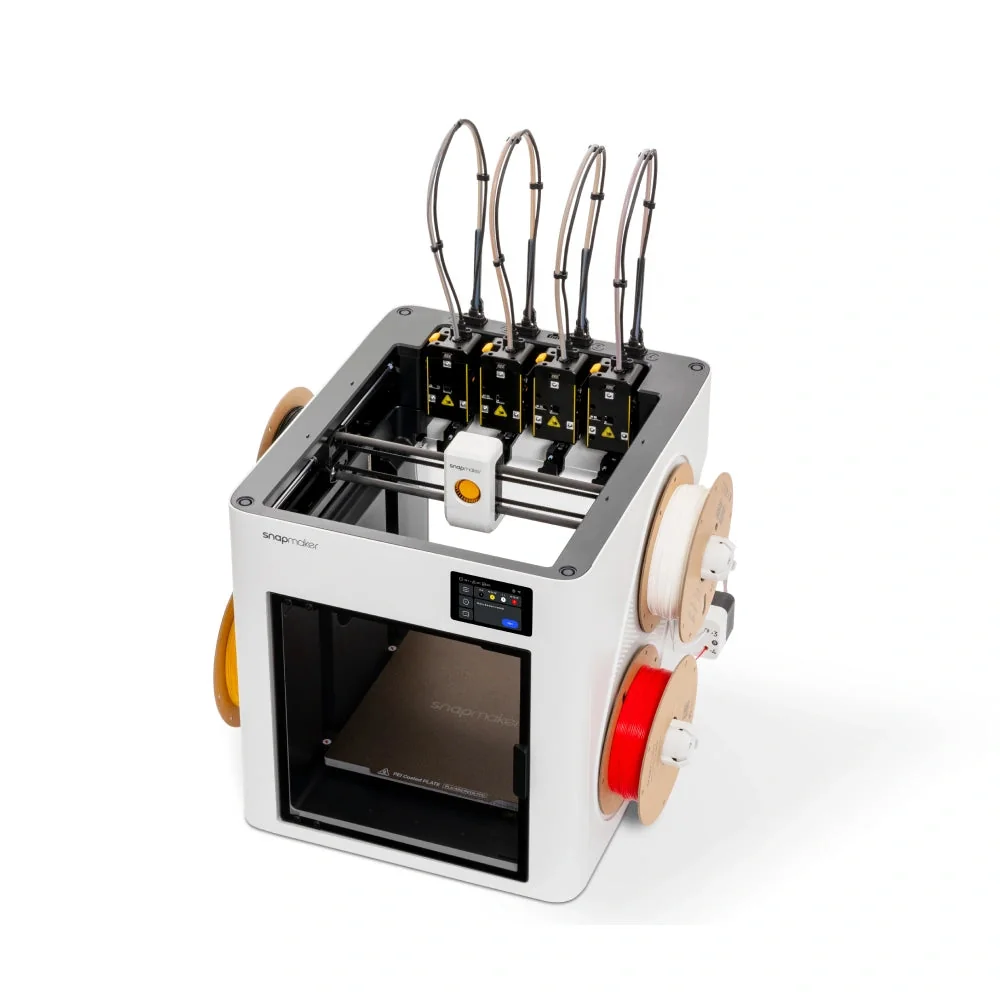
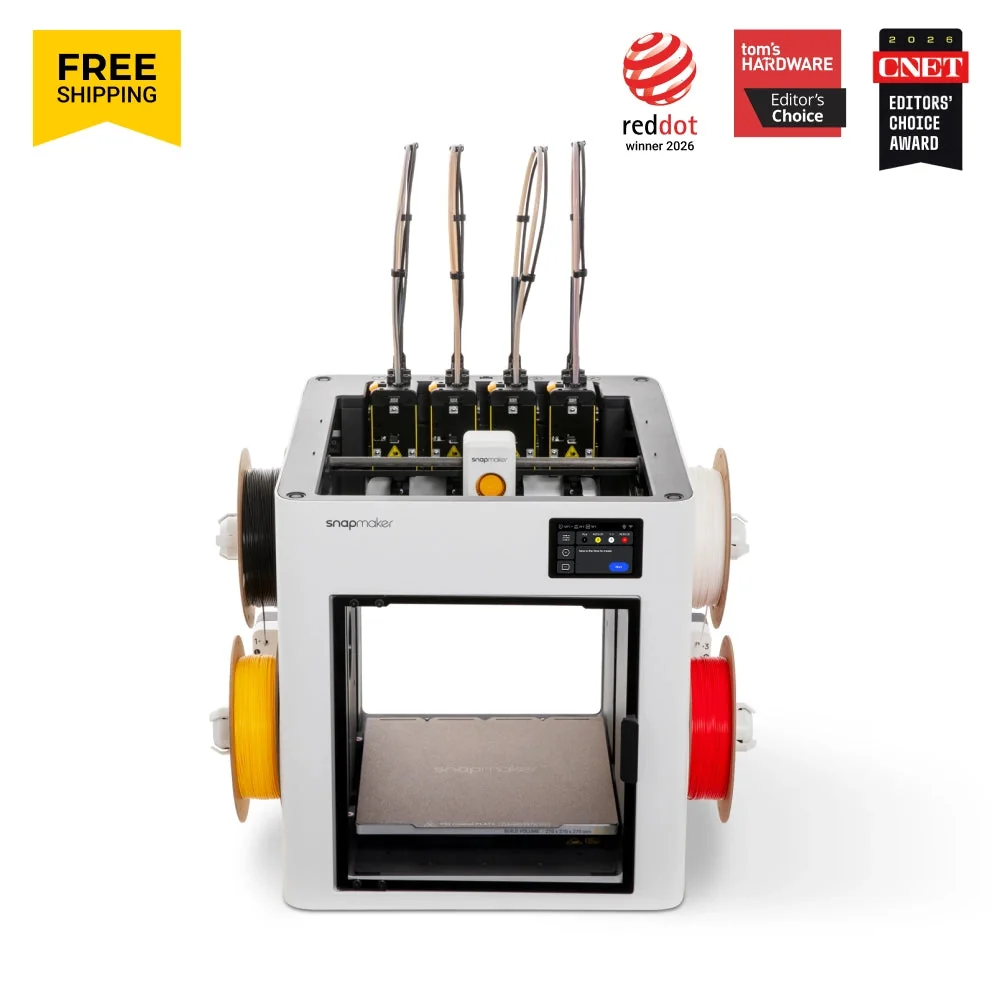
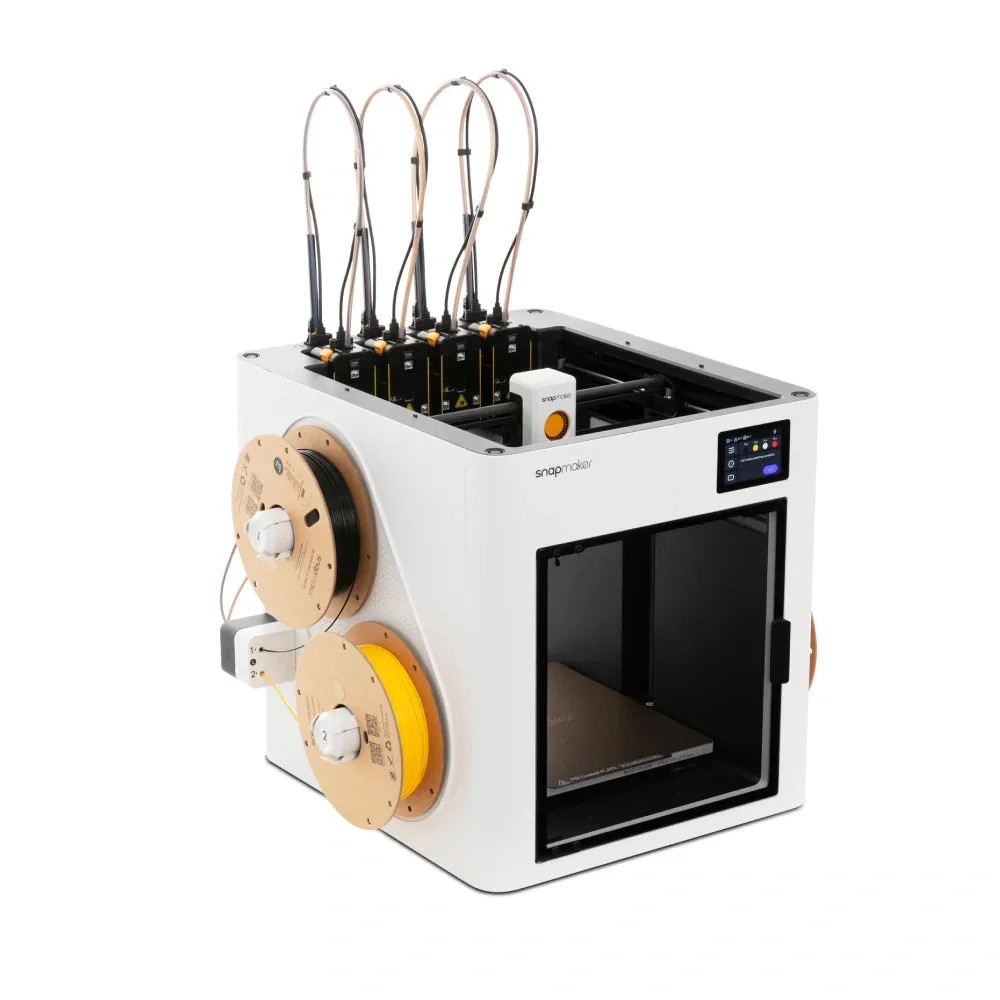
Snapmaker U1 (4-toolhead)
By Snapmaker · 3D Printers · 3D Printing
- 4 toolheads via SnapSwap tool-changing system
- 270 x 270 x 270 mm build volume
- ~5 second tool change time
- Carbon-fiber X-axis rails, lightweight print head
Lowest price seen
$849.00
from $849.00 at Snapmaker (US official store) · Checked Sep 28, 2026
- Snapmaker (US official store) $849.00View at Snapmaker (US official store)
- Snapmaker Global (D2C) $849.00View at Snapmaker Global (D2C)
- MatterHackers $849.00View at MatterHackers
- eBay $1,202.00View at eBay
- Micro CenterView at Micro Center
- eBay (used) eBay: used, open-box, refurbishedView at eBay (used)
- AmazonView at Amazon
Prices are snapshots. Check the current price with the store.
Summary
A CoreXY printer with four independent toolheads that swaps them in seconds, bringing true multi-color and multi-material printing to a price well under a thousand dollars. The catch is first-generation maturity: filament feed jams, toolhead anomalies and a loud chassis recur across owner reports, so buy it for the toolchanger, not for set-and-forget reliability.
Strengths
- Four complete hotends stay loaded, so color changes take seconds and purge waste nearly vanishes.
- A genuine four-head toolchanger for well under a thousand dollars undercuts premium multi-tool machines by a wide margin.
- Tom’s Hardware found good print quality, fast color changes and low filament waste.
- The 270 mm cube is a generous build volume for this class.
- Automatic calibration, pressure-advance and flow compensation, toolhead offset calibration and runout detection cut setup work.
- Plenty of owners report hundreds of hours without a hiccup.
Weaknesses
- Filament loading and unloading jams are the most repeated complaint, with deformed tips snagging at the extruder gears.
- Clearing a jam deep in a toolhead can demand a long teardown with many different screws.
- Toolhead-swap anomalies appear on some units; some recover on resume, others ruin long prints.
- It is loud — fans, motion noise, squeaks and audible tool-change clicks recur across owners and reviewers.
- The Top Cover is an optional extra, so quieter running and engineering materials cost more.
- The proprietary hotend is replaced only as a whole assembly; nozzle, heater and sensor are not individually serviceable.
Verified specifications
| Type | FDM CoreXY with four independent SnapSwap toolheads; advertised tool change in about 5 seconds (Tom’s Hardware measured 10–12 seconds on a beta unit). |
|---|---|
| Build volume | 270 × 270 × 270 mm. |
| Dimensions | 584 × 499 × 730 mm, 18.2 kg — treat this as the required operating envelope, not just the chassis. |
| Motion | up to 500 mm/s and 20,000 mm/s² acceleration. |
| Hotends | four proprietary 0.4 mm stainless hotends (the FAQ adds one spare); up to 300 °C and 32 mm³/s flow; 1.75 mm filament. |
| Bed | textured PEI flexible steel sheet, up to 100 °C. |
| Electronics | Klipper firmware with Moonraker and Fluidd access; 3.5-inch 320 × 480 touchscreen; 26 GB storage; 2 MP chamber camera; 2.4 GHz Wi-Fi and USB; 400 W maximum input power. |
| Filament ID | proprietary RFID recognition for Snapmaker spools, even though the Klipper, Moonraker and Fluidd modifications are open source. |
| Materials | PLA, PETG, TPU, PVA and PCTG; the optional Top Cover expands the official list; CF and GF filaments need a hardened nozzle. |
| In the box | printer, PEI sheet, four toolheads with hotends, four 500 g spools of PLA, four filament holders, two filament feeders, waste collector, toolhead cables, tools and guides. |
| Warranty | one year on the main printer (two years in EU, CH, NO and IS); extruders and filament holders only three months; hotends, nozzles, PEI sheets and PTFE tubes are consumables with no warranty. |
Full research notes and sources
The toolchanger, in practice
The pitch is simple: instead of pushing four filaments through one nozzle, the U1 keeps four complete hotends ready and physically swaps them. On jobs with hundreds of color changes, that saves both wall-clock time and purge-tower filament, which is where the value compounds. Snapmaker advertises a swap in about five seconds; Tom’s Hardware’s beta unit took roughly 10–12 seconds, and its 90-swap three-color test finished about three hours faster than a comparable Bambu P1P print with a 4 g prime tower. “Zero Purge” is marketing rather than literal: Snapmaker’s own FAQ documents a small prime tower used to clear filament that degrades while a nozzle waits hot. The mechanism is rated for 1,000,000 swaps and each toolhead’s pogo pins for 250,000; the printer counts swaps and prompts contact cleaning every 100,000. 3DWithUs found the retail workflow consistent over several weeks.
Maturity: what owners actually hit
The recurring complaint family is feeding, not toolchanging: automatic unload leaving deformed tips, jams around the extruder gears, feeder and spool-holder problems, MCU communication errors, and the occasional toolhead anomaly — some of which clear on resume, others of which kill long prints. When a jam sits deep in a toolhead, owners describe teardowns with a small pile of screw types. Early production batches also had loose inner panels, and firmware updates have occasionally introduced regressions. Two balancing facts: other owners report hundreds of clean hours, and Snapmaker’s support earns positive mentions even inside critical threads. Snapmaker also documents the service path unusually well, from hot ends and toolhead PCBAs (under five minutes to replace, per Snapmaker) down to belts, motors and control boards. Retail availability began in 2026, so long-term failure data does not exist yet.
Noise
Nobody has published a trustworthy standardized measurement; one secondary review claims above 70 dB, but owner experience varies. The consistent description is a noticeably loud machine: part fans, part CoreXY motion, part squeaks and the audible click of every tool change. Owners compare it unfavorably with common Bambu printers and report hearing it through closed doors. Fine for a garage or workshop; a poor choice for a bedroom or quiet shared space, unless you add the Top Cover and accept the extra cost.
Is it worth it?
For a maker who runs frequent three- or four-color or multi-material prints and does not mind hands-on troubleshooting, the U1 is exceptional value — no other true toolchanger comes close at this price. If most of your printing is one or two colors, a cheaper and more mature printer will be quieter and simpler, and single-color buyers gain little from four hot ends. And if you need more than four simultaneous materials or out-of-the-box enclosed ABS, this is not your machine.
Which model this is
This page covers the Snapmaker U1 four-toolhead CoreXY printer. It is not the Snapmaker J1 or J1s IDEX machines or the Artisan modular platform, which are different designs, and it is not a single-nozzle multi-color system.
Sources
Manufacturer:
- Snapmaker U1 product page (US store)
- Snapmaker U1 full specifications
- Snapmaker U1 FAQ
- Snapmaker U1 warranty policy
- Snapmaker launch and pricing blog
- Snapmaker U1 wiki: FAQ, maintenance and swap-life data
- Snapmaker U1 wiki: maintenance and replacement index
Independent reviews:
- Tom’s Hardware Italia hands-on review of the U1
- Tom’s Hardware review of the U1
- 3DWithUs hands-on toolchanging test
Owner reports:
- Loose panels on early units (Snapmaker forum)
- Owner issues and 400-hour report (r/snapmaker)
- Owner regrets and repeated toolhead problems (r/SnapmakerU1)
- Filament unloading trouble (r/SnapmakerU1)
- Toolhead anomaly errors (r/snapmaker)
- Feeding issues (r/snapmaker)
- Fault on a fresh-unboxed toolhead (r/snapmaker)
- Support resolution for a hub-board issue (r/SnapmakerU1)
- A week of loading and toolhead problems (r/snapmaker)
- Noise discussion (r/SnapmakerU1)
- Hundreds of clean hours reported (r/snapmaker)