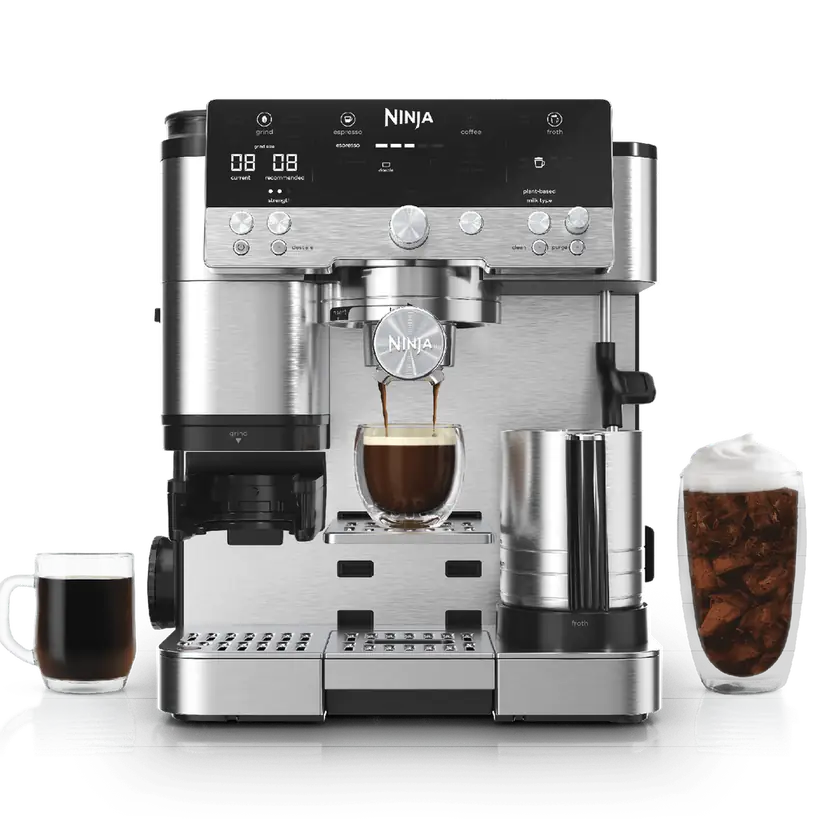
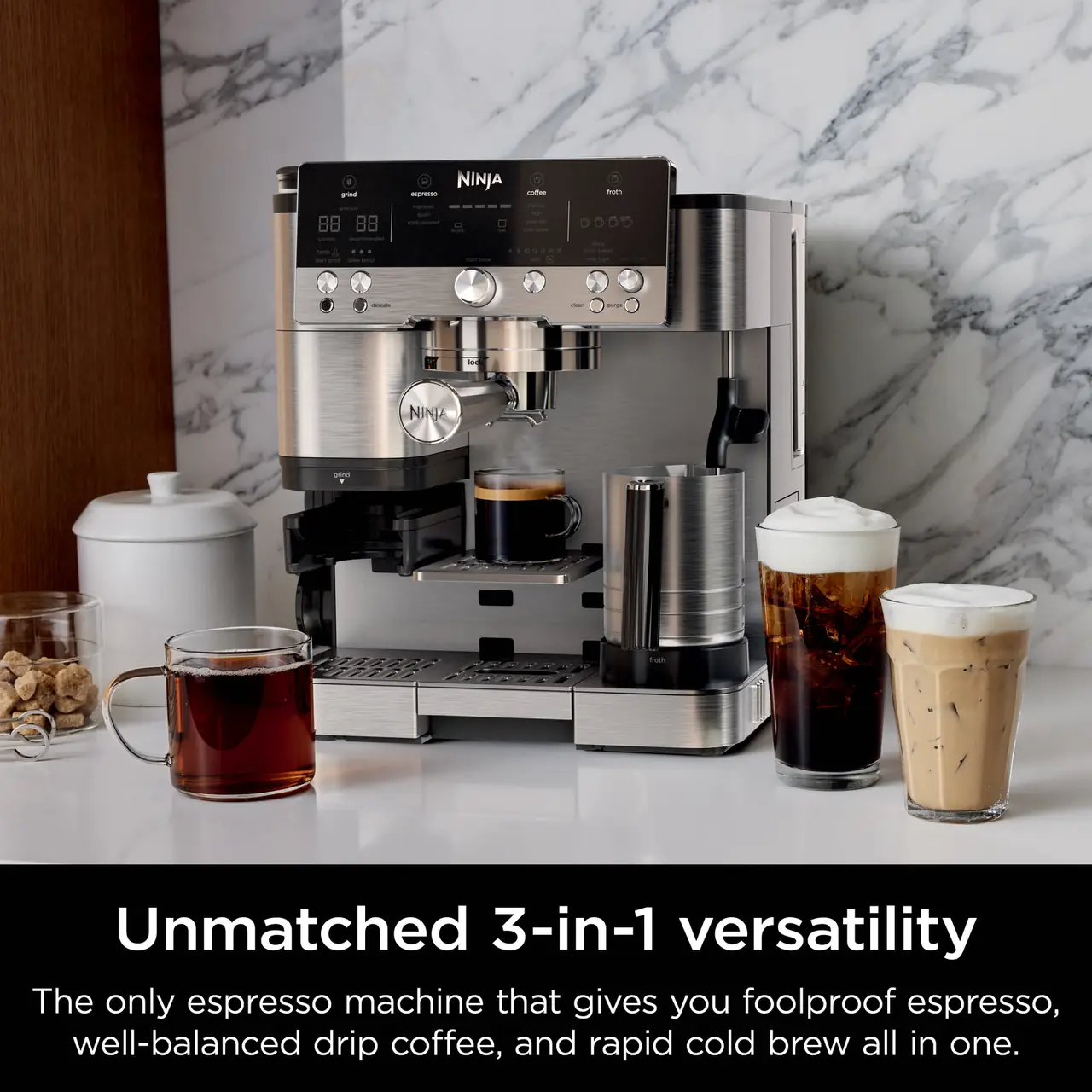
Ninja Luxe Cafe Premier 3-in-1 Espresso Machine
By Ninja · Espresso Machines · Kitchen & Cooking
- Conical burr grinder with 25 grind settings from espresso to drip
- Built-in scale with weight-based dosing (17-18 g doses measured in testing)
- Barista Assist Technology recommends grind size and auto-adjusts brew temperature and time
- 1,650 watts, 120 volts
- Product dimensions 15.75 in L x 15.24 in W x 20.51 in H
Lowest price seen
$429.95
from $429.95 at eBay · Checked Oct 12, 2026
- eBay $429.95View at eBay
- Abt $599.99View at Abt
- NinjaView at Ninja
- TargetView at Target
- WalmartView at Walmart
- Best BuyView at Best Buy
- Macy'sView at Macy's
- Nebraska Furniture MartView at Nebraska Furniture Mart
- The Home DepotView at The Home Depot
- Kohl'sView at Kohl's
- JCPenneyView at JCPenney
- eBay (used) eBay: used, open-box, refurbishedView at eBay (used)
- AmazonView at Amazon
Prices are snapshots. Check the current price with the store.
Summary
A guided 120 V bean-to-cup machine that grinds, doses, tamps and froths milk in a jug, aimed at beginners who want espresso, drip coffee and cold brew from one countertop unit. Check whether you can live without a pressure gauge or manual brew control, because this model has neither.
Strengths
- Integrated grinder, scale and assisted tamper remove the need for separate espresso gear.
- Weight-based dosing follows published targets for single, double and quad shots.
- Hands-free jug frothing with four presets, so there is no steam-wand technique to learn.
- Seven drip-coffee sizes plus cold brew and cold-press drinks from the same machine.
- A 70 oz reservoir and integrated accessory storage keep the counter organized.
- Tom’s Guide’s several-week test found consistent crema and repeatable froth.
Weaknesses
- No pressure gauge and no brew-pressure readout, and no user-set brew temperature.
- The grind recommendation drifts; the manual says 2-3 brews may be needed after a bean change.
- Owners report inconsistent shot volumes, with outputs from the same 18 g dose ranging roughly 45 g to 77 g.
- Descaling and cleaning are mandatory and prompt-driven; drink quality drops if a descale is skipped once the light is on.
- First-party spec blocks disagree, and one lists an impossible 0.06 lb weight.
- No lab-style instrumented test was found, so measured temperature, pressure and yield are unknown.
Verified specifications
| Model | ES601 (Premier Series); color variants ES601GM (Gunmetal Gray) and ES601BK (Midnight Black). |
|---|---|
| Power | 1,650 W at 120 V, 60 Hz, per the owner guide. |
| Reservoir | 70 oz. |
| Grinder | integrated conical burr grinder with 25 settings, 1 finest and 25 coarsest. |
| Dosing | built-in scale; nominal 9 g single espresso, 18 g double and 40 g quad, with 0.8 oz, 1.5 oz and 3.5 oz outputs and a stated plus or minus 10% tolerance. |
| Coffee volumes | 6, 8, 10, 12, 14, 16 and 18 oz for Classic and Rich; 6 to 18 oz for Over Ice and Cold Brew. |
| Brew paths | espresso, drip coffee and cold brew, plus cold-press espresso and a cold-foam setting. |
| Frothing | whisk integrated in the milk jug, four foam presets and a dairy/plant-based milk setting. |
| Dimensions | 12.99 × 13.39 × 14.57 in. |
| Weight | 25.7 lb. |
| Cord | 43 in; the manual says not to use an extension cord. |
| Setup | a tap-water hardness test must be run and entered before normal use. |
| Warranty | one (1) year limited, US. |
Full research notes and sources
Guided brewing, not manual control
Barista Assist Technology recommends a grind size from the beans and the previous brew output, and the user turns the side dial to match. The recommendation is a moving target: the manual states it can take 2-3 brews with new beans to reach the optimal setting, and that it changes as beans age. There is no pressure gauge, no manual pump control and no user-set brew temperature, so anyone who wants to read or steer pressure should look elsewhere.
Dosing is unusually well documented. The manual prints nominal doses and outputs with a stated tolerance: single espresso 9 g in and 0.8 oz out, double 18 g in and 1.5 oz out, quad 40 g in and 3.5 oz out, with cold-pressed doubles and quads using the same 18 g and 40 g, and outputs varying by plus or minus 10%. Drip and cold-brew volumes run 6, 8, 10, 12, 14, 16 and 18 oz. Roast switching is the friction point: the tester had to empty the hopper, run the grinder to clear old beans and let the machine recalibrate, and found filter coffee made with espresso-roast beans came out very strong.
Independent testing is thin. Tom’s Guide’s tester used the machine for several weeks and reports around 20 seconds to grind a dose and around one minute to brew a double shot. Coffeeness measured repeatable 18 g in and 36 g out doubles in roughly 25-30 seconds. No RTINGS, CNET, PCMag or Wirecutter test of ES601 was found.
Frothing and milk
Frothing is a different mechanism from a steam wand. The milk sits in a stainless jug on a magnetic platform with a whisk in the base, the jug has 2, 5 and 8 oz measure lines, and the reviewer reports quiet, repeatable froth across four presets with automatic wand purge when the jug is lifted. Cold foam is available and does not heat the milk. Coffeeness found that manual steaming produced better microfoam, so treat the automatic frother as consistent rather than barista-grade.
Reliability, parts and running costs
Owners report the most repeated issue is shot-volume inconsistency: one owner reported roughly 46 g, 77 g and 50 g outputs from the same nominal 1:2 setup and stopped shots with a separate scale, and another reported 45-50 g from an 18 g dose. A long-term owner went through three Premier units whose grinder recommendations would not hold. There are harder failures too: one owner reported water routing into the drip tray, and an overseas owner reported the grinder stopping after about four months. Another family with two units reported no failures, and CoffeeGeek flags mounting tabs cracking and heavy water use. No statistically valid defect rate exists for any of it.
Maintenance is mandatory rather than optional. A tap-water hardness test must be run and entered before normal use, and it drives the descale prompt. The CLEAN and DESCALE buttons light when a cycle is due, the manual warns that drink quality will decline if a descale is skipped, and the clean cycle needs the included disc plus a cleaning tablet and discharges into the drip tray.
SharkNinja sells the consumables and spares directly: cleaning tablets $14.99, descaling powder $14.99, portafilter $43.99, single basket $19.95, milk jug $29.99 and main drip tray $13.99 (SharkNinja, 2026). Running costs are beans, milk and cleaning supplies: one double espresso a day at the documented 18 g target uses about 6.57 kg of beans a year, an eight-pack of cleaning tablets plus a four-pack of descaling powder costs $29.98, and drawing the full 1,650 W for 20 minutes a day would be about 200.8 kWh a year, or about $36.77 at the July 2026 US residential average of 18.31 cents/kWh. There is no subscription or proprietary service fee.
Is it worth it?
SharkNinja lists the US ES601 at $499.99 (SharkNinja, 2026), and the machine’s case rests on integration: grinder, scale, dosing guidance, assisted tamping and hands-free frothing in one 25.7 lb unit with a 70 oz tank. At $450 or less it is a strong buy for a mixed-drink household, and from about $451 to $500 it stays a strong buy. From about $501 to $550 the value is fair, and above $550 the $599.99 Ninja Luxe Cafe Pro or the $549.95 De’Longhi La Specialista Arte Evo is easier to justify (SharkNinja and De’Longhi, 2026). Walmart’s exact listing runs around $599 (Walmart, 2026), and Best Buy has moved between $499.99 and $599.99 (Best Buy, 2026). The reviewer’s comparison above this tier is a roughly $700 fully automatic Philips that cannot make iced drinks (Tom’s Guide, 2025). If you want a conventional hands-on workflow, the Breville Barista Express is $499.95 (Breville, 2026).
Which model this is
This page covers the Ninja Luxe Cafe Premier Series 3-in-1 espresso machine, model ES601, sold in the US in Stainless Steel, Gunmetal Gray (ES601GM) and Midnight Black (ES601BK), and the listing this page follows is ASIN B0D45PK5V4. Do not merge it with the 4-in-1 Ninja Luxe Cafe Pro, the Luxe Cafe Mini Plus, the AutoBarista Pro, or the UK and Australian SKUs ES601UKBK and ES601EU, whose published weights, dimensions and warranty terms differ from the US model.
Sources
Manufacturer:
- SharkNinja US: Ninja Luxe Cafe Premier Espresso Machine, Model ES601
- SharkNinja US: Ninja Luxe Cafe Premier Espresso Machine Grey, Model ES601GM
- Ninja Kitchen US: Ninja Luxe Cafe Premier Series, Model ES601
- SharkNinja Support: ES600 Series Ninja Luxe Cafe drink guide
- Ninja Luxe Cafe Owner’s Guide (PDF, SharkNinja)
- SharkNinja US: Home Barista Bundle ES601BKB1 (replacement parts and consumables)
Independent reviews:
- Tom’s Guide: Ninja Luxe Cafe coffee maker review
- Tom’s Guide: Ninja Luxe Cafe vs Breville Barista Express
- TechRadar: Ninja Luxe Cafe review
- Coffeeness: Ninja Luxe Cafe ES601 hands-on review
- CoffeeGeek: Ninja Luxe Cafe Premier full review
- Costco: exact ES601 specifications and manual listing
Owner reports:
- Shot-volume and water-waste owner report (r/NinjaLuxeCafe)
- One year and three replacement units (r/NinjaLuxeCafe)
- Water routed to the drip tray instead of the portafilter (r/NinjaLuxeCafe)
- Espresso quality and extraction discussion (r/espresso)
- Owners discuss shot output and overall satisfaction (r/NinjaLuxeCafe)
- Reliability discussion (r/NinjaLuxeCafe)
- Overseas grinder failure and warranty experience (r/espresso)
- ES601 owner reviews (Best Buy)
Parts and stores: