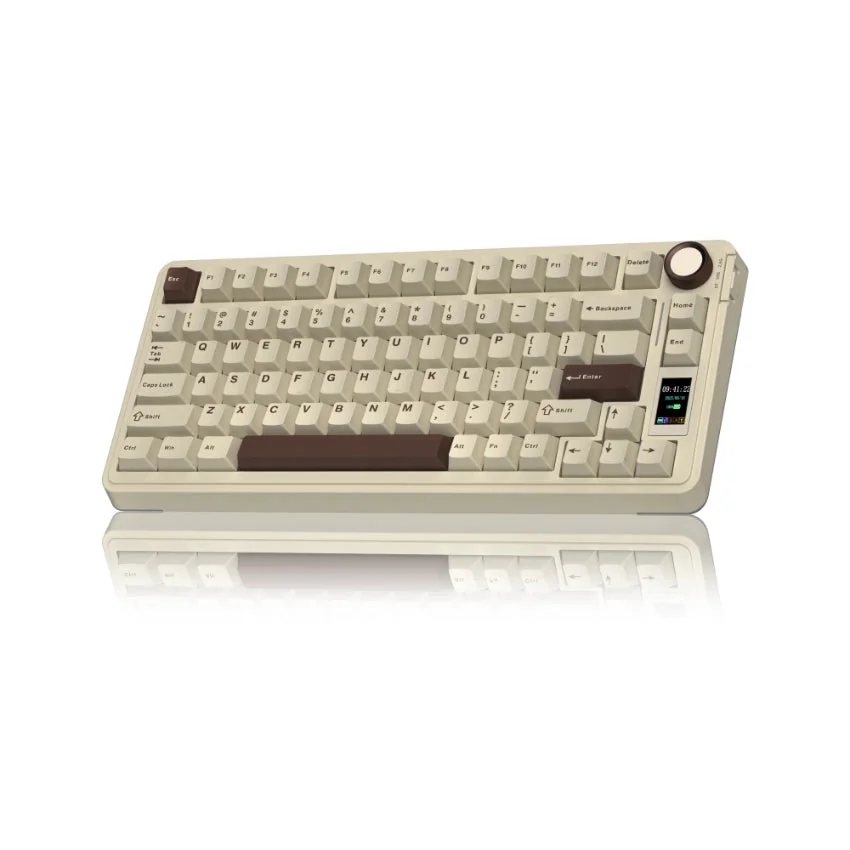
Logitech G 316 98
By Logitech G · Mechanical Keyboards · Home & Workspace
- 8 kHz report rate
- 40 g actuation force, 1.9 mm actuation distance, 3.5 mm travel
- 880 g weight without cable
- 1.8 m cable
- 384 mm depth
Lowest price seen
~$99.99 (approx.)
from $99.99 at Amazon
- Amazon ~$99.99 (approx.)View at Amazon
- Logitech GView at Logitech G
- eBay (used) eBay: used, open-box, refurbishedView at eBay (used)
- eBayView at eBay
- NeweggView at Newegg
Prices are snapshots. Check the current price with the store.
Summary
A wired mechanical keyboard that keeps the number pad in a narrower frame, with hot-swappable switches, an 8,000 Hz polling mode and a media dial. Before you buy, check the owner reports of random disconnects and the fact that the USB cable is permanent.
Strengths
- RTINGS bought and lab-tested a sample and found very low, consistent gaming latency.
- TechRadar’s hands-on praised the tactile response, PBT keycaps and solid, non-flexing chassis.
- The dial handles volume, media, brightness and polling, backed by an animated dot-matrix display.
- Switches and caps swap without soldering, and Logitech sells a matching decorative keycap and dial kit.
- The layout keeps a number pad and full F-key row while dropping some navigation keys.
- Reversible rubber feet give 4° or 8° of tilt, which TechRadar found stable and grippy.
Weaknesses
- It is wired only — no Bluetooth or 2.4 GHz option — so it permanently occupies a USB port.
- Home, End and some navigation keys move to Fn combinations, which frustrates shortcut-heavy workflows.
- Owners report random disconnects tied to firmware and lighting profiles, with no confirmed root cause.
- The Tactile sample tested loud, with a somewhat rattly spacebar and sticky, heavy larger keys.
- The dot-matrix screen shows elementary status animations rather than useful information.
- No switch or keycap puller is included, and bent pins can damage hot-swap sockets.
Verified specifications
| Layout | 98-key “98%” board with number pad and top F-key row; RTINGS classifies it as compact 96%, with Home/End and some navigation keys on Fn shortcuts. |
|---|---|
| Construction | plastic case, gasket-mounted assembly with acoustic damping, double-shot PBT shine-through keycaps, hot-swappable conventional mechanical switches, per-key RGB and a 30-zone lightbar. |
| Switches | Linear and Tactile factory variants; retailer tolerances list linear at 1.9 ± 0.4 mm actuation and 40 ± 8 g, tactile at 2.2 ± 0.4 mm and 55 ± 10 g. No magnetic or analog actuation is specified. |
| Polling | 1,000 / 2,000 / 4,000 / 8,000 Hz selectable with the knob; the 0.125 ms report interval at 8,000 Hz is not input latency. |
| Connection | detachable USB-A to USB-C wired data cable; no Bluetooth, 2.4 GHz receiver or battery. |
| Controls | Game Mode button, press-and-rotate dial (hold 1.5 seconds to pick a mode), dot-matrix status display, and 4° or 8° tilt from reversible rubber foot blocks. |
| Dimensions | about 384 × 140 × 40 mm; a retailer listing gives 384.5 × 140.33 × 40.69 mm. |
| Weight | about 880 g; the retailer listing says 870 ± 50 g. |
| Software | G HUB handles remapping, RGB and game mode; retailer specifications list two onboard profiles. |
| Compatibility | Windows 10+ and macOS 12+ documented in independent specifications. |
| In the box | keyboard, detachable data cable, documentation; the manual says no switch or keycap puller is included. |
| Warranty | two-year limited hardware warranty on gaming products from the US Logitech G shop. |
Full research notes and sources
Typing feel, sound and build
Gasket-mounted assembly and acoustic damping keep flex low, and TechRadar’s September 30, 2026 hands-on praised the tactile response, PBT caps and solid plastic chassis. RTINGS bought and lab-tested a White Tactile sample and published a strong assessment of single-key and multi-key latency and 8,000 Hz performance; its detailed millisecond figures are subscriber-locked, so this review claims no exact measured input latency, and any advantage over a good 1,000 Hz board is likely small for most people. TweakTown’s tactile sample felt different: larger keys were sticky, heavy and noisy, and the board landed among the louder models it reviewed. Those findings come from the Tactile variant and should not be transferred to Black Linear without confirmation. Nobody has published a calibrated noise figure for the Black Linear unit, so treat loudness as a variant-by-variant question.
Firmware, disconnects and owner reports
r/LogitechG threads between July and October 2026 describe a pattern worth knowing before you buy. On August 7, an owner reported repeated disconnects with several cables on a Windows PC and suspected a loose USB-C socket. On September 9, another owner traced reconnect loops to the latest firmware while running a solid-color lighting profile; switching back to the default G-Tide preset restored normal operation, and a September 30 reply reported the same lighting-dependent issue plus a key that sometimes stuck midgame. A third owner reported a linear-switch unit that randomly powered off on recent firmware, and on October 2 an owner described idle RGB shutoff and lighting-integration oddities without the whole keyboard failing. Two plausible causes have emerged, firmware-lighting interaction and individual port seating, and neither is a manufacturer-confirmed root cause. Nobody has published a failure rate, so treat this as a known annoyance rather than a defect. The owner-reported workaround is to run the G-Tide preset with the provided cable plugged directly into a stable port; if problems persist across cables and ports, document the issue and use Logitech’s warranty route. In the September 9 thread, a Logitech representative said the issue had been forwarded to the team; that is acknowledgment, not evidence that a fix shipped. Other owners in the same threads describe enjoying the board in daily use.
Parts, repairs and running costs
The keyboard has no scheduled replacement intervals and no mandatory subscriptions; it draws power over USB and carries no battery to age. An illustrative estimate assumes 3 W average draw over 8 hours a day, 365 days a year, on a $0.20 per kWh tariff: 8.76 kWh, or about $1.75 a year. Nobody has metered real-world draw, so treat that as an illustration rather than a power bill. Customization is the main optional cost. The official G-KEYCAPS kit is $29.99 from Logitech’s US shop (October 2026) and adds 20-plus decorative caps and a matching dial, not a full replacement set. Switches are removable without soldering, and TweakTown successfully swapped its tactile sample for spare linear switches, though that is not a guarantee that any 5-pin switch fits. Logitech has not published US prices for a standalone replacement cable, foot blocks or internal boards, and parts listed only for the G316 X 75, G512 or G915 should not be bought without confirming fit. The US Logitech G shop covers gaming products with a two-year limited hardware warranty and advertises 30-day free returns; keep your invoice, part number and serial. A Singapore-region 920-014221 purchase is not automatically covered the same way as a US 920-014213 one.
Is it worth it?
The research draws editorial lines at $85, $100 and $120: below $85 is a particularly good deal for a new unit, $85–$100 is competitive for this wired format, and $100–$120 is fair only if you want the keypad, 8,000 Hz polling, G HUB and the lightbar and dial. Above $120, the research points to the Keychron V5 Max at $119.99 from Keychron’s US warehouse if wireless operation and QMK/VIA support matter more, or to the Logitech G512 X 98 TMR at $199.99 if adjustable magnetic actuation is the point. Store checks in October 2026 found Logitech’s own US shop listing $99.99, reduced from $119.99; Walmart at $90.23 for the Black Tactile and $119.99 for the Black Linear; and Best Buy listing the Black Linear 920-014213 at $119.99. Prices move, and switch and color variants are listed separately, so confirm the exact configuration before checkout.
Which model this is
This page covers the Logitech G316 X 98, a wired mechanical keyboard announced for US release on June 30, 2026 at $119.99 MSRP and sold in Linear and Tactile switch variants. In US retail numbering, the Black Linear is 920-014213 and the Black Tactile is 920-014183. The manufacturer page supplied for this project ends in 920-014221, which a Singapore reseller identifies as Black Linear with UPC 097855212917; regional part numbers are not identical, so match part number and color before buying. Independent testing so far covers the White Tactile (RTINGS) and Tactile variants (TweakTown, TechRadar hands-on); no instrumented Black Linear 920-014213 test has been published. The board launched in June 2026, so no multiyear failure statistics exist.
Sources
Manufacturer:
- Logitech G US — G316 X 98 product page
- Logitech — G316 X 98 setup guide (PDF)
- Logitech newsroom — G3 series US launch, June 2026
- Logitech G US — G-KEYCAPS PBT keycaps and dial
- Logitech G US — shop terms: 30-day returns, two-year warranty
Independent reviews:
- RTINGS — independently bought and tested review
- TechRadar — hands-on review, September 30, 2026
- TweakTown — tactile model review, July 28, 2026
- ConferencingWorks — dimensions, switch specs, warranty
Owner reports:
- Firmware issue and lighting-linked disconnects (r/LogitechG)
- USB-C, disconnects and firmware discussion, July–September 2026 (r/LogitechG)
- Long-term owner experience, October 2, 2026 (r/LogitechG)
Prices and stores:
- Logitech G US — October 2026 gaming deals
- Walmart — Black Tactile, $90.23
- Walmart — Black Linear, $119.99
- Best Buy — Black Linear 920-014213
- Kaira Global Singapore — 920-014221 identified as Black Linear
Alternatives mentioned: