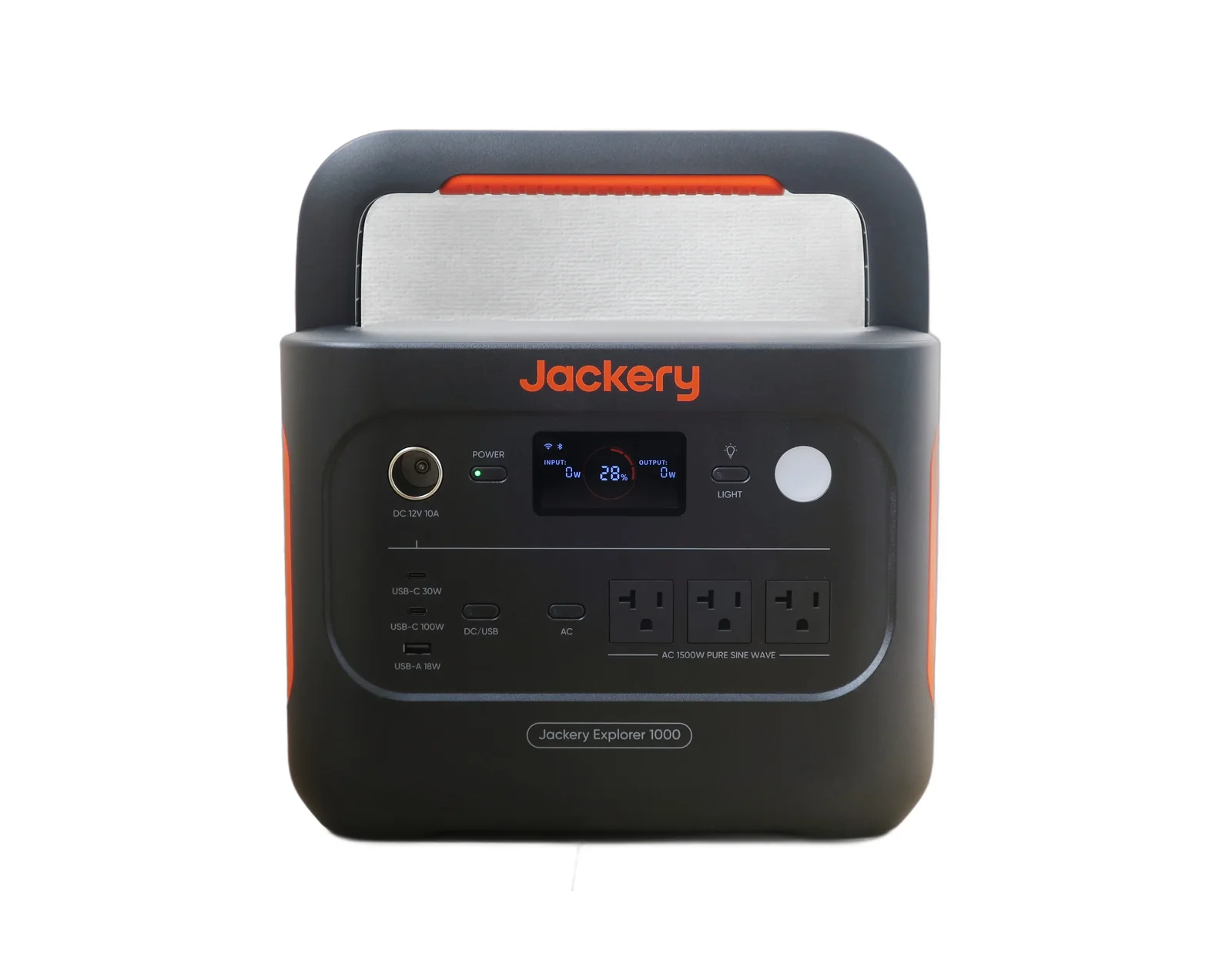
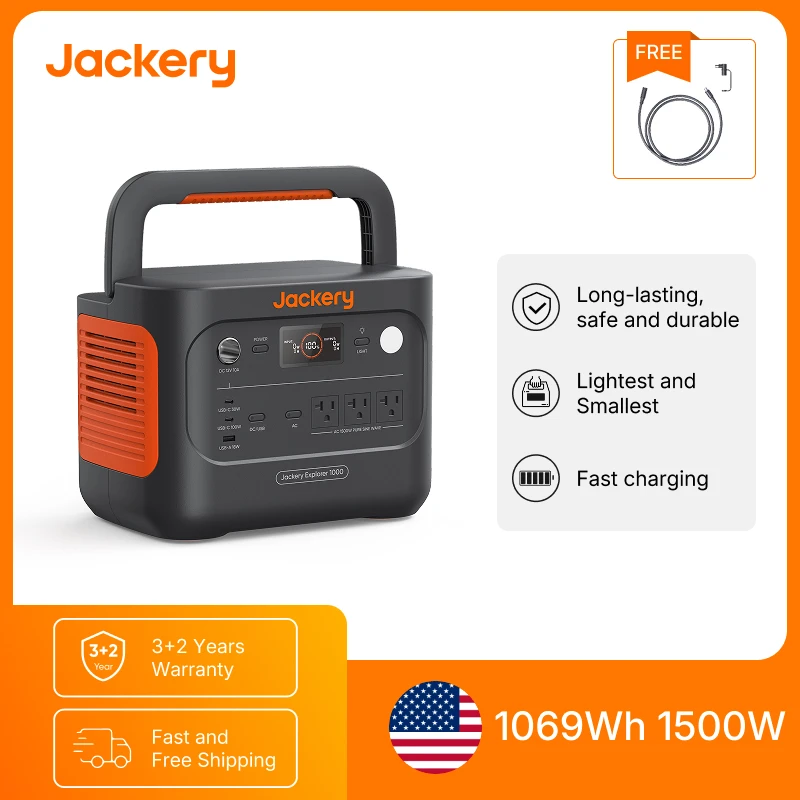
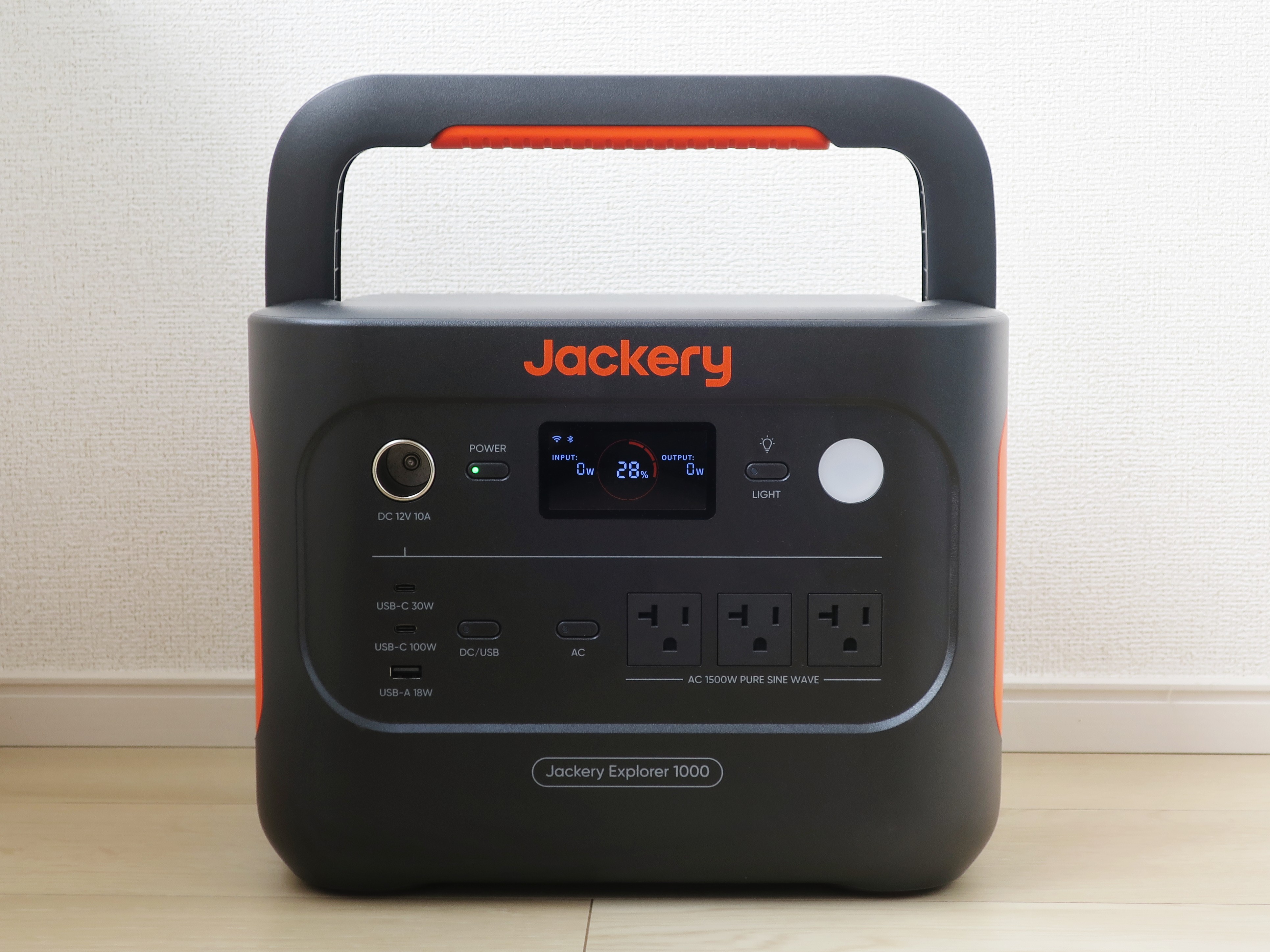
Jackery Explorer 1000 v2
By Jackery · Portable Power Stations · Audio & Electronics
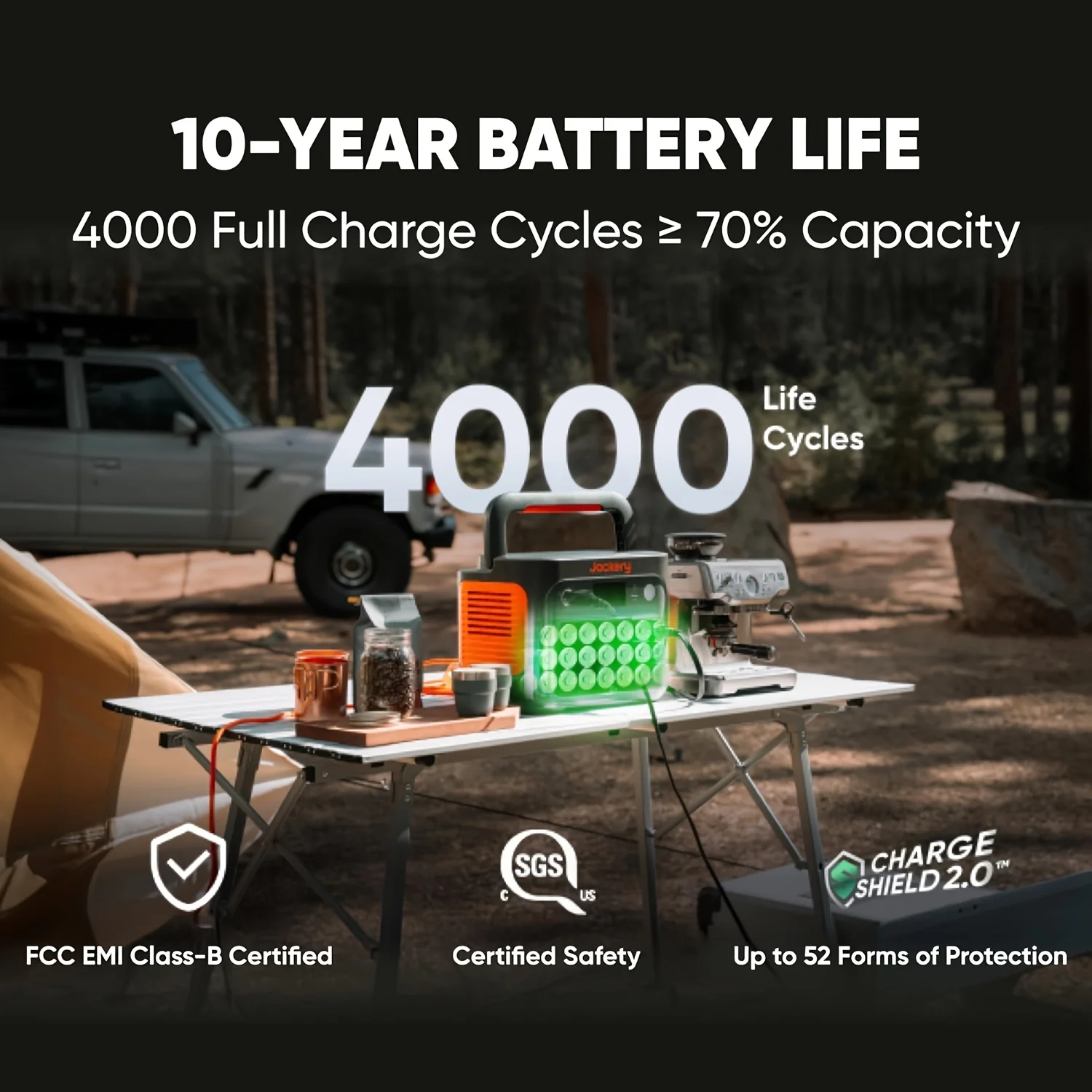
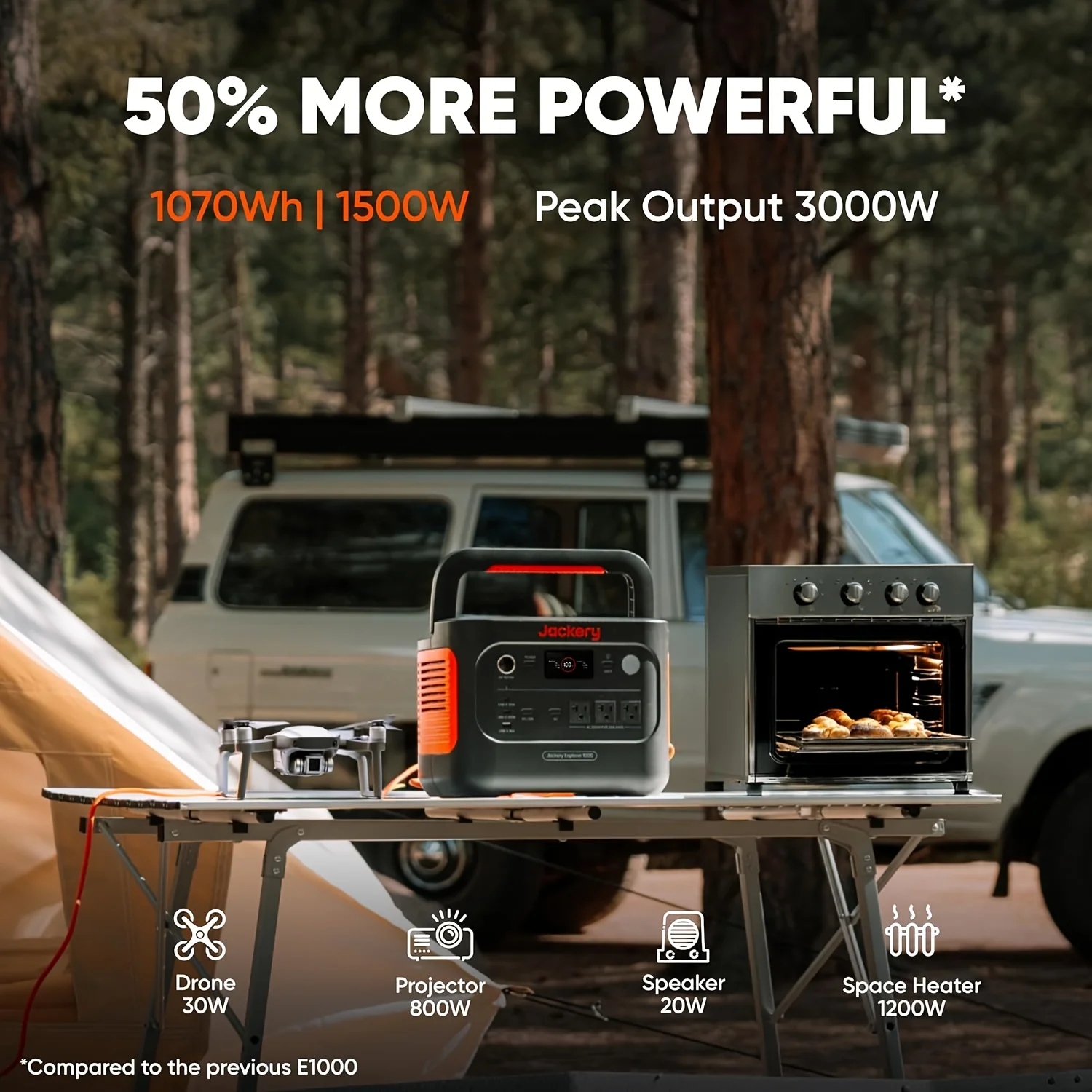
- 1,070Wh LiFePO4 battery, rated 4,000+ cycles to 70% capacity
- 1,500W continuous output / 3,000W surge
- 1-hour fast AC charge
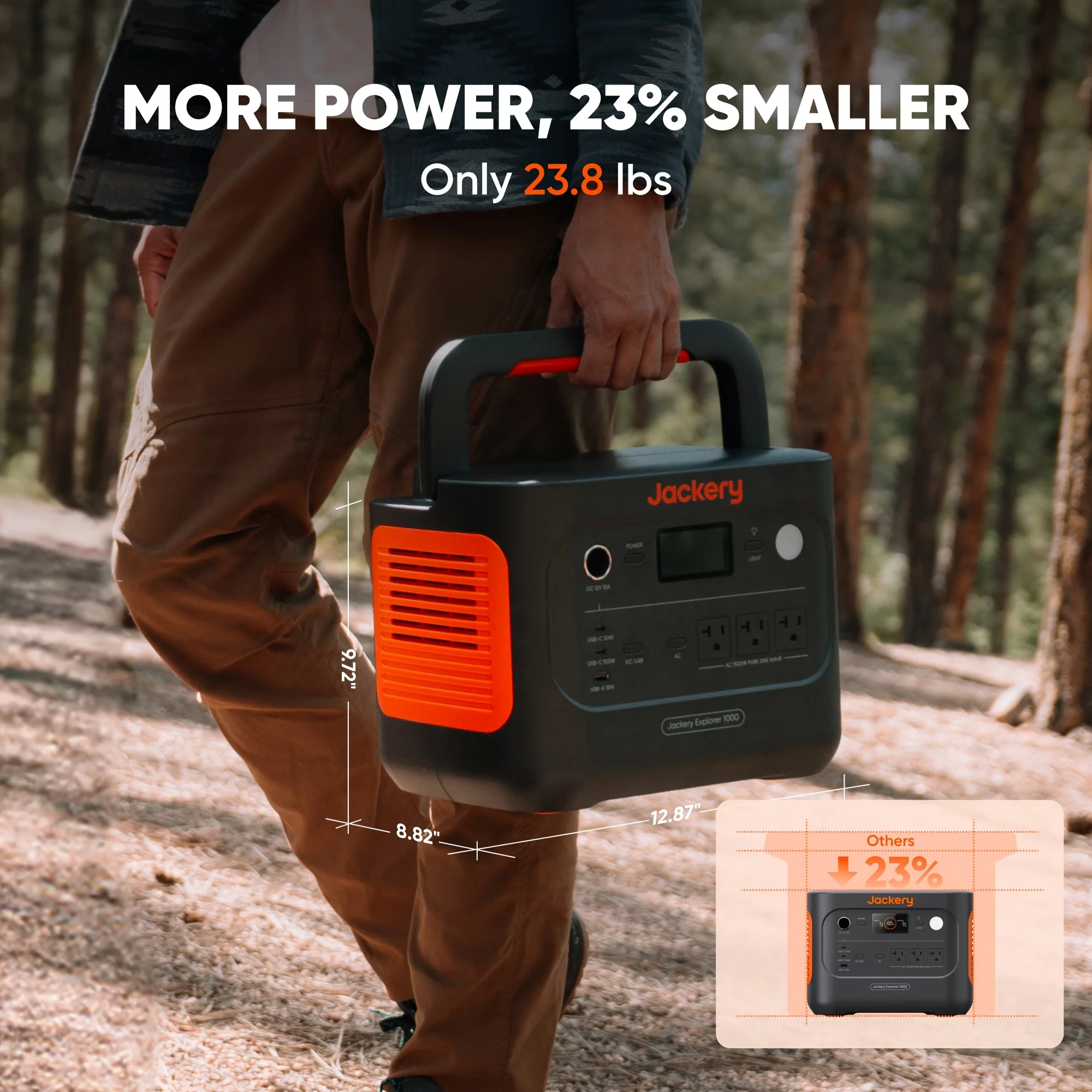
- Weighs 24 lbs
- ChargeShield 2.0 safety system, UL2743 certified
Lowest price seen
$463.09
from $463.09 at AliExpress · Checked Oct 12, 2026
- AliExpress Jackery US Direct Store $463.09View at AliExpress
- eBay $488.00View at eBay
- Earthtech Products $489.00View at Earthtech Products
- Jackery $559.00View at Jackery
- CSE Solar USA $559.00View at CSE Solar USA
- Best BuyView at Best Buy
- Lowe'sView at Lowe's
- Jackery Store (jackerystore.com)View at Jackery Store (jackerystore.com)
- eBay (used) eBay: used, open-box, refurbishedView at eBay (used)
- AmazonView at Amazon
Prices are snapshots. Check the current price with the store.
Summary
A portable 1,070 Wh LiFePO4 power station — 23.8 lb, 1,500 W AC output, fast wall charging — sized for camping, CPAP and refrigerator backup through short outages. Check your growth plans first: the battery cannot be expanded, and solar input stops at 400 W.
Strengths
- 23.8 lb for a full kilowatt-hour is unusually portable; owners describe it as manageable between house, vehicle and campsite.
- LiFePO4 chemistry and a 4,000-cycle rating mean occasional backup use will not exhaust the battery quickly.
- Standard wall charging lands around 1.6–1.7 h, far quicker than older Jackery generations, with an emergency mode for urgent top-ups.
- Quiet operation recurs in owner reports, including a CPAP user whose sleep was not disturbed.
- App charge-rate modes let you trade charging speed for noise and current draw, which helps on weak circuits or vehicle inverters.
Weaknesses
- No expansion battery: what you buy is what you keep.
- 1,500 W continuous ceiling with less headroom than 1.8–2.0 kW rivals; over-limit loads trip rather than throttle.
- 400 W solar ceiling, and real-world input normally lands below nameplate anyway.
- USB-C cannot charge the station; both ports are output-only.
- The 20 ms battery takeover is not a true UPS; Jackery itself warns it is not for servers or workstations.
- The newer DC8020 solar socket accepts older DC7909 plugs that look seated but do not make contact — an adapter is required.
Verified specifications
| Battery | 1,070 Wh LiFePO4 (30.4 Ah / 35.2 V DC), rated for 4,000 cycles to 70%+ original capacity. |
|---|---|
| AC output | three 120 V / 60 Hz outlets, 1,500 W continuous, 3,000 W surge, pure sine wave. |
| DC | 12 V / 10 A car outlet. |
| USB | USB-C 100 W plus USB-C 30 W plus USB-A 18 W; both USB-C ports are output-only and cannot charge the station. |
| Solar input | two DC8020 ports, up to 400 W combined at 16–60 V, 21 A combined maximum. |
| AC charging | about 1.58 h standard; an app-controlled emergency mode approaches 1 h. |
| Car charging | about 12 h. |
| UPS/bypass | 1,500 W bypass with battery takeover within 20 ms — not a true 0 ms UPS. |
| Charging temperature | 32–113°F (0–45°C); discharge 14–113°F (-10–45°C). |
| Dimensions | 12.87 × 8.82 × 9.72 in (32.7 × 22.4 × 24.7 cm); 23.8 lb (10.8 kg). |
| Housing | PC + ABS high-strength plastic. |
| Warranty | 3 years standard, extendable by 2 years to 5 under Jackery registration terms. |
| In the box | power station, AC charging cable, user manual; solar bundles add the panel and cable, so a panel is not included with the standalone unit. |
Full research notes and sources
Charging behavior and the solar connector
Multiple owners report slower-than-expected charging — roughly 230–370 W instead of the fast-charge figure. Often the cause is the app’s quiet mode, a cold battery, initial balancing or the taper near full rather than a fault, but at least one 2026 unit genuinely failed to AC-charge and was returned. If charging stays abnormally slow after mode and temperature checks, contact support. Solar adds a second trap: older DC7909 panel plugs can slide into the newer DC8020 socket without making contact, so verify your adapter before diagnosing the station as unable to solar-charge.
Running a fridge and a CPAP
A March 2026 CPAP owner reported about 10 hours on a ResMed 10 with humidification on and roughly 42% of the battery left — one real example, not a guaranteed runtime. Refrigerator duty appears in successful owner reports too. One caveat: at least two owners had trouble running ICECO compressor fridges from the 12 V car port, particularly on compressor restart, while the same fridges ran fine through their 120 V adapters. If your fridge misbehaves on 12 V, try the AC outlet before blaming the station.
Storage, care and warranty
No population failure rate exists in the evidence, so treat isolated F1-fault and dead-unit posts as individual cases. Store the pack within the stated temperature range, keep vents clear, avoid leaving it fully depleted for long storage, and test your backup loads before an outage rather than during one. The warranty is 3 years standard and advertised as extendable to 5 with registration — read the terms at purchase instead of assuming the 5 years is unconditional. Noise stays low in normal use: Jackery lists the cooling fan at up to 22 dB, but under meaningful load independent measurements run higher.
Is it worth it?
Buy it on sale. Jackery’s own store listed the new BASIC variant at $499 against a $799 reference during a promotion (Jackery, 2026). Discounted, the combination of low weight, quiet running, quick recharge and long-cycle chemistry is easy to recommend for camping and short-outage duty. Near full list price the case weakens sharply, because competing stations offer more inverter output, higher solar limits or expandable batteries. Judge it by usable energy, not the label: inverter losses put real AC output below 1,070 Wh, though one 2026 independent test measured 91–94% of stored energy delivered at 300–800 W loads — that tester’s result, not an official spec. Check the store panel above for current prices.
Which model this is
This page covers the US 120 V Explorer 1000 v2, Jackery’s compact LiFePO4 station with the fold-down handle. It is a fixed-capacity unit with no expansion path, so buyers planning to grow a system should start on an expandable platform. Secondary pages sometimes list a different weight and dimensions; Jackery’s current US specification, used here, is 23.8 lb and 12.87 × 8.82 × 9.72 in.
Sources
Manufacturer:
- Jackery Explorer 1000 v2 product page
- Jackery support: Explorer 1000 V2 basic information
- Jackery support: user manual access
Independent reviews:
Owner reports:
- CPAP runtime report (r/Jackery)
- Slow charging thread (r/Jackery)
- AC charging failure, unit returned (r/Jackery)
- Older slow-charge discussion (r/Jackery)
- DC7909 plug in a DC8020 socket (r/Jackery)
- Repeated F1 faults (r/Jackery)
- ICECO fridge on 12 V (r/Jackery)
- Vehicle inverter and quiet-charge workaround (r/Jackery)