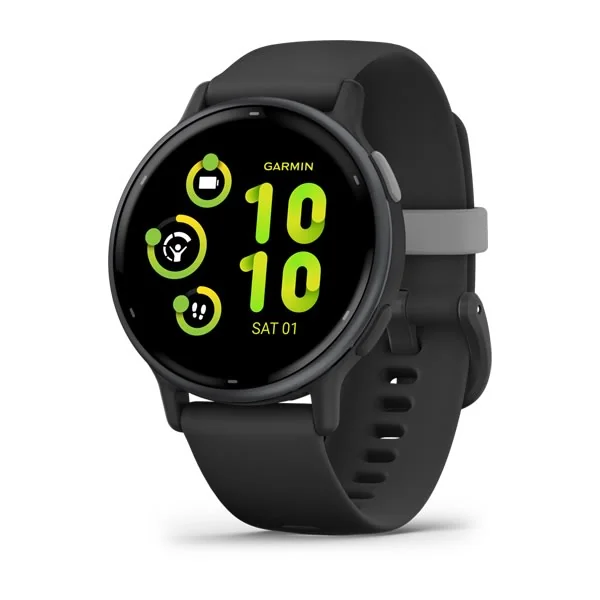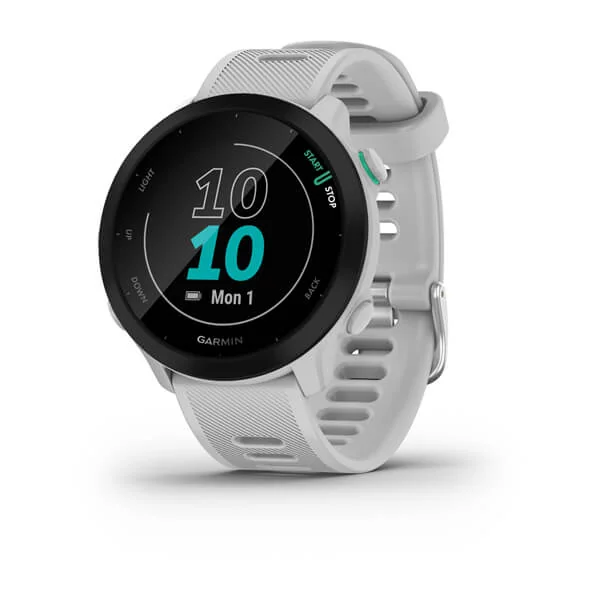
Garmin Forerunner 55 (Black)
By Garmin · Fitness Trackers · Phones & Computers
- 42 x 42 x 11.6 mm
- 37 g
- 1.08 in 208x208 display
- Up to 2 weeks smartwatch / 20 h GPS
- 5 ATM
Lowest price seen
~$199.99 (approx.)
from $199.99 at Amazon
- Amazon ~$199.99 (approx.)View at Amazon
- GarminView at Garmin
- Best BuyView at Best Buy
- WalmartView at Walmart
- eBay (used) eBay: used, open-box, refurbishedView at eBay (used)
- eBayView at eBay
Prices are snapshots. Check the current price with the store.
Summary
An entry-level GPS running watch for beginner and intermediate runners, with a bright transflective display, a fast GPS lock and up to two weeks of battery in smartwatch mode. Check two things before buying: there is no music storage, contactless payment or SpO2 sensor, and owners report the built-in battery fading after a few years.
Strengths
- Fast GPS lock: under 5 seconds in testing, against 15–30 seconds on the older Forerunner 45.
- Battery life met Garmin’s claims in testing: a week of 24/7 tracking used about 50%, a single GPS run about 2%.
- PacePro pacing, suggested workouts and recovery-time guidance carry over from higher-end Forerunner models.
- Button navigation is preferred over a touchscreen during sweaty workouts.
- The Garmin Connect app and Garmin Coach training plans are free, with no subscription.
- Incident detection and LiveTrack are rare at this price.
Weaknesses
- No onboard music storage, so you run with a phone or another player.
- No contactless payments and no SpO2 (blood oxygen) sensor.
- The stock silicone band is not user-swappable.
- The 208 × 208 display has not changed since the Forerunner 45 and is low-resolution next to newer watches.
- Owners report the built-in battery fading after 1.5–3 years, some from 14 days down to 4.
- Single-band GPS drifts in cities, tree cover and trails.
Verified specifications
| Model | 010-02562-00, the black Forerunner 55; Garmin lists 010-02562-50 for the black variant on some regional pages. |
|---|---|
| Dimensions | 42 × 42 × 11.6 mm; 37 g; fits wrists up to 203 mm. |
| Display | 1.08 in transflective MIP, 208 × 208; Garmin’s own spec page lists 1.04 in (26.3 mm) diameter. |
| Battery | up to 2 weeks in smartwatch mode, up to 20 hours in GPS mode; built-in rechargeable lithium-ion. |
| Water resistance | 5 ATM, pressure-equivalent to 50 m. |
| GPS | built-in single-band GPS; no multi-band. |
| Sensors | Garmin Elevate optical heart rate and an accelerometer. |
| Connectivity | Bluetooth and ANT+; no Wi-Fi. |
| Case | fiber-reinforced polymer with chemically strengthened glass, not Gorilla Glass. |
| Storage | 32 MB; no onboard music storage. |
| Charging | standard Garmin USB-A charging cable. |
| Operating temperature | -20 to 60 °C (-4 to 140 °F); charging 0 to 45 °C (32 to 113 °F). |
| Band | silicone with perforations, replaceable only with a 20 mm quick-release band. |
| In the box | watch and a Garmin USB-A charging cable. |
Full research notes and sources
Battery life and charging
Garmin rates the watch at up to 2 weeks in smartwatch mode and up to 20 hours in GPS. In testing a week of continuous tracking used about half the battery and a single GPS run used about 2%. Long-term owners got weeklong GPS trips from a charge, and Treeline Review had it back to full within an hour. The battery is built in and not user-replaceable.
The warning signal is aging. Garmin forum threads report degradation after 1.5–3 years, with one owner seeing 14 days drop to 4. Battery indication can also misbehave: one thread describes the watch showing 100%, dropping to 1% and dying, fixed for that owner by a factory reset. Garmin does not offer an official battery replacement; in one forum report support told an owner its battery could not be replaced and offered a replacement watch at cost, though that report was about a different Garmin model. Nobody has published a failure rate, so treat this as a known aging risk rather than a defect.
GPS and heart rate accuracy
GPS locks fast and is accurate on open ground: Tom’s Guide saw locks under 5 seconds, TechRadar checked a pre-measured 3-mile route and found it recorded to within a few yards, and both called the tracking hard to beat for the money. The catch is single-band GPS. FitnessTechTrends found it fine on open roads but drifting in cities, tree cover and trails next to a multi-band rival, and Reddit owners describe long waits and the screen cycling between “Wait for GPS” and the run screen.
Heart rate and step data are the softer part of the package. Treeline Review, after a year of daily wear, called the heart rate “sometimes wildly inaccurate” at the start of workouts and found step count and elevation gain that disagreed with Strava and an iPhone. Mileage was occasionally off on familiar loops. Heart rate is also not shown on screen during workouts by default.
What it lacks
There is no music storage, no Garmin Pay, no SpO2 sensor, no touchscreen, no Wi-Fi and no barometric altimeter, so elevation comes from GPS alone. There is no dedicated strength-training profile, no sleep score or interpretation, and the Connect IQ app selection is small compared with higher-end Garmin watches. For a beginner-focused watch these omissions are the trade you make for the price and the battery life.
Is it worth it?
The Forerunner 55 launched at $199.99 on June 2, 2021. At review time TechRadar found it listed for $199.99 at Best Buy, Performance Bicycle and Fleet Feet. Around a $150–160 street price the value improves, and it keeps a place as a cheap way into Garmin’s running ecosystem; at $200 you should weigh the Forerunner 255 and 265, which add multi-band GPS and a barometric altimeter for more money.
It suits a new runner who wants basic GPS tracking, guided training and long battery life without advanced metrics. It makes less sense if you want music on your wrist, contactless payment or blood-oxygen tracking, and older stock may be drying up now that newer Forerunner models are on sale.
Sources
Manufacturer:
Independent reviews:
- Tom’s Guide: Garmin Forerunner 55 review
- TechRadar: Garmin Forerunner 55 review
- Treeline Review: training with the Forerunner 55
- FitnessTechTrends: Forerunner 55 vs Coros Pace 3
Owner reports: