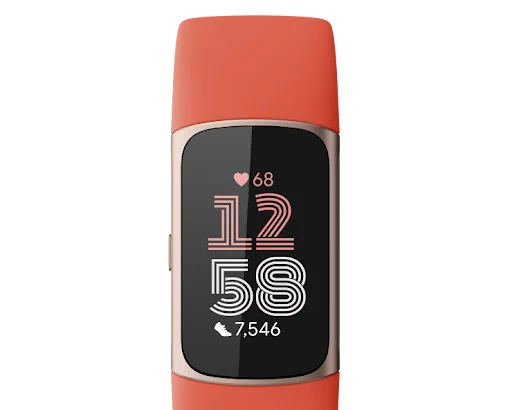
Fitbit Charge 6 (Obsidian/Black)
By Fitbit · Fitness Trackers · Phones & Computers
- 1.04-inch AMOLED display
- Up to 7 days battery life
- 5 ATM water resistance
- Built-in GPS + GLONASS
- 30g weight
Lowest price seen
~$159.95 (approx.)
from $159.95 at Amazon
- Amazon ~$159.95 (approx.)View at Amazon
- FitbitView at Fitbit
- TargetView at Target
- eBay (used) eBay: used, open-box, refurbishedView at eBay (used)
- eBayView at eBay
Prices are snapshots. Check the current price with the store.
Summary
A slim fitness band with a 1.04-inch AMOLED screen, built-in GPS, an optical heart-rate sensor and ECG and EDA apps, sold as model GA05183-NA in the Obsidian and Black colorway. The two things to weigh first are the Premium subscription behind the best insights and the unreliable running GPS.
Strengths
- Built-in GPS and an ECG app are rare at this price.
- The physical side button is a real step up from the Charge 5’s touch-only controls.
- Battery lasts days, not hours, and the band is slim and comfortable.
- Sleep and step tracking match dedicated devices in independent tests.
- Google Maps and Wallet on the wrist, plus heart-rate streaming to gym equipment.
- Full charge in about two hours over the same cable as the Charge 5.
Weaknesses
- Running GPS is the weakest part: reviewers report drop-outs and lock failures.
- Daily Readiness, advanced sleep detail and wellness reports need a Premium plan.
- No Spotify control and no third-party app store; only YouTube Music, and its controls need their own subscription.
- No altimeter, so stairs and elevation are not tracked.
- The screen is small to read mid-run, and the proprietary charger attaches loosely.
- Requires a Google Account, and the sealed body means repair is usually replacement.
Verified specifications
| Display | 1.04-inch AMOLED with Corning Gorilla Glass 3. |
|---|---|
| Dimensions | 36.73 × 23.09 × 11.20 mm (manufacturer). |
| Weight | 30 g (manufacturer). |
| Battery | lithium-polymer, rated up to 7 days; about 2 hours to full charge. |
| Water resistance | 5 ATM, up to 50 m (ISO 22810:2010). |
| Positioning | built-in GPS plus GLONASS. |
| Sensors | optical heart-rate monitor, 3-axis accelerometer, red and infrared SpO2 sensors, skin-temperature sensor, ambient light sensor, vibration motor, NFC, and electrical sensors for the ECG and EDA Scan apps. |
| Memory | 7 days of minute-by-minute motion data and 30 days of daily totals; heart rate at 1-second intervals during exercise and 5-second otherwise. |
| Operating temperature | 14 to 113°F; max operating altitude 28,000 ft. |
| Compatibility | Google Health app on Android 11.0+ or iOS 16.4+. |
| Charging | proprietary magnetic USB-A cable, the same cable as the Charge 5. |
| In the box | tracker, Infinity band in small and large, and a charging cable; no power brick. |
Full research notes and sources
Battery life and charging
Fitbit rates the Charge 6 at up to 7 days with always-on display off. Independent testing came in lower and depended on settings: PCMag measured about 4.5 days in normal use and 3 days with always-on at full brightness, CNET got 4 to 5 days and just under 2 with always-on, and Wareable saw roughly a 15 to 20 percent drop per day, about 5 days, falling to 3 to 4 with always-on. GearLab measured just under 7 days of continuous use plus about 8 hours of GPS.
GPS and heart-rate broadcasting are the drains. A 30-minute built-in-GPS run cost Wareable almost 30 percent of the battery, against 7 percent on connected GPS, and CNET found an hour of heart-rate broadcasting to Strava used almost 20 percent. Recharging is proprietary and slow next to a phone: about two hours to full, with no spare battery to swap.
Heart rate and GPS
Heart-rate accuracy is good in steady states and shakier when intensity changes fast. GearLab measured it within about plus or minus 3 bpm of a Polar H10 chest strap. PCMag saw lag of up to about 40 seconds behind a chest strap and an Apple Watch Series 9 after sprints, and higher averages on a 30-minute run, while it matched closely on yoga. CNET found it within a few bpm of a chest strap on a HIIT workout but a couple of seconds slow on spikes. Wareable got close agreement on rowing and steady runs but readings significantly higher on a treadmill.
GPS is the clear weak spot. TechRadar called it severely flaky, and the problem worsened when the band was fastened tightly, which is exactly how you wear it for good heart-rate readings. Wareable and CNET both saw lock failures and route drop-outs. GearLab found GPS accurate on open trails but off by about 0.86 miles on a steep-hill test, and PCMag found it mostly matched an iPhone 15 on distance. Runners should lean on connected GPS from a phone.
Sleep and health tracking
Sleep tracking is a strength. Wareable found duration and stages tracked closely with an Oura Ring Gen 3, and PCMag measured 8.5 hours of sleep against 9 hours on a Sleep Number and 9.5 on a Nest Hub, with scores in the 80s. The ECG app held up in Wareable’s testing against an Apple Watch Ultra 2 and a pulse oximeter. Onboard there is an SpO2 sensor, a skin-temperature sensor and the EDA Scan app for stress.
Vitals beyond the basics are gated. Daily Readiness Score, detailed sleep and stress insights and wellness reports live behind Fitbit or Google Health Premium.
Subscriptions and app
The tracker needs a Google Account and the Google Health app. Fitbit or Google Health Premium costs $9.99 a month or $79.99 a year for Daily Readiness, advanced sleep insights and wellness reports. If the YouTube Music controls matter, YouTube Music Premium adds about $11 a month, for a combined potential of about $21 a month. A six-month Premium trial has been included at launch.
There is no Spotify control and no app store, so the software side is narrower than a smartwatch. App quality draws steady complaints from owners, several of whom say the app has felt worse since the Google takeover.
Durability, repairs and warranty
The band and charging cable are the user-serviceable parts; the tracker itself is sealed. Fitbit’s warranty says the devices contain integrated components whose repair, like cracked screens or faulty batteries, may not be possible outside Fitbit’s factory, and units may be swapped for refurbished ones. There is no user-replaceable battery. In the US the limited warranty runs one year, the EEA gets two, and certified refurbished units get 90 days. Security updates are promised for the Charge 6 until at least February 2028.
Durability is a live concern. One owner reports three consecutive Charge models dying at 12 to 14 months, just outside the warranty, and an owner aggregator lists hardware and touchscreen failures among the common complaints. Band quality draws complaints too, including a Wareable reviewer’s clasp breaking within two days and skin rashes some owners trace to the stock silicone band. Fitbit’s care guidance is to keep the band clean and dry, use only fresh water, remove the device for an hour after extended wear, and avoid sunscreen and insect repellent.
Is it worth it?
At or below roughly $130 the Charge 6 is strong value as a dedicated tracker with built-in GPS and multi-day battery. Google Store lists it at $159.95, and discounts are frequent: review deal modules have shown street prices in the low $130s. The hidden cost is the Premium subscription needed to unlock the advertised readiness and sleep insights. If you need reliable running GPS, an altimeter, Spotify, an app store or best-in-class heart-rate accuracy, this is the wrong device; for steps, sleep, gym workouts and casual GPS on a slim band, it stays a strong pick.
Which model this is
This page covers the Google Fitbit Charge 6, model GA05183-NA, in the Obsidian and Black colorway. The North America SKU is GA05183-NA, with a sibling part number GA05184-NA used in some US listings; the hardware is identical across the Obsidian, Porcelain/Silver and Coral/Champagne Gold colors, and only the case and band color differ. The Amazon listing for the Obsidian/Black unit is ASIN B0CC62ZG1M.
Don’t confuse it with the Charge 5, which has no physical side button, no Google apps and no YouTube Music, or the Charge 4, which has a recessed button.
Sources
Manufacturer:
Independent reviews:
- Tom’s Guide: Fitbit Charge 6 review
- PCMag: Fitbit Charge 6 review
- CNET: Fitbit Charge 6 review
- TechRadar: Fitbit Charge 6 review
- Wareable: Fitbit Charge 6 review
- GearLab: Fitbit Charge 6 review
Owner reports:
- Fitbit Charge 6 problems: what real owners report (ownersreview)
- Looking at getting the Charge 6, does it have issues? (r/fitbit)
- Anybody NOT have issues with the Charge 6? (r/fitbit)
Fitbit Support: