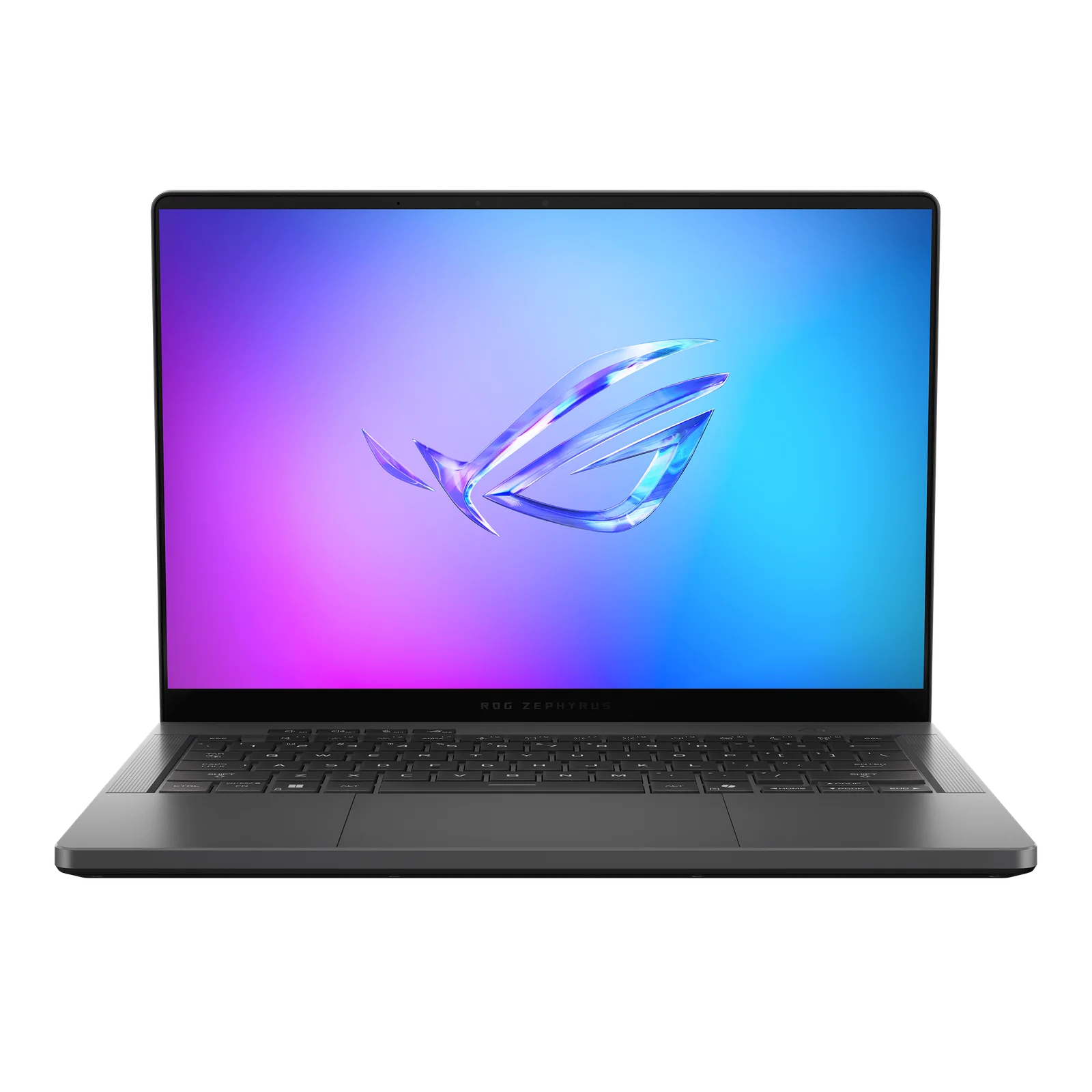
ASUS ROG Zephyrus G14 (2025, GA403)
By ASUS · Laptops · Phones & Computers
- AMD Ryzen AI 9 HX 370 processor
- NVIDIA GeForce RTX 5070 or 5080 graphics
- 14-inch OLED display
- Up to RTX 5080 in a 3.3 lb chassis
Lowest price seen
~$2,499.99 (approx.)
from $2,499.99 at Amazon
- Amazon ~$2,499.99 (approx.)View at Amazon
- ASUSView at ASUS
- eBay (used) eBay: used, open-box, refurbishedView at eBay (used)
- eBayView at eBay
- Best BuyView at Best Buy
- WalmartView at Walmart
- NeweggView at Newegg
Prices are snapshots. Check the current price with the store.
Summary
A compact 14-inch gaming laptop with up to RTX 5080 and Ryzen AI 9 HX 370 in a 3.3–3.5 lb aluminum chassis. Check the fan noise and heat under load before buying — it is the most consistently cited complaint across all reviews.
Strengths
- OLED display with 100% DCI-P3, Pantone Validated, and 120 Hz refresh rate.
- Keyboard described as “one of the best keyboards on the laptop market” by Notebookcheck.
- Speaker system praised as better than most competitors including the Razer Blade 14.
- Port selection considered generous for a 14-inch laptop.
- Battery life for general productivity reported at 5–10 hours depending on configuration and workload.
- Ryzen AI 9 HX 370 praised for efficiency and strong multi-core performance.
Weaknesses
- Fan noise under load is the most consistently cited complaint across all reviews.
- Heat buildup: rear and underside get “uncomfortably hot” during gaming.
- PWM display dimming at ~960 Hz may cause eye strain for sensitive users.
- Soldered RAM means no post-purchase memory upgrades.
- One Reddit owner reported three motherboard replacements within ~10 months.
- The RTX 5070 version uses the older, less powerful Ryzen 9 270 CPU and runs the GPU at 90W.
Verified specifications
| Model | GA403 (multiple sub-models). |
|---|---|
| Processor | AMD Ryzen 9 270 (8c/16t, up to 5.2 GHz, 16 TOPS NPU) on 5050/5060/5070 models; AMD Ryzen AI 9 HX 370 (12c/24t, up to 5.1 GHz, 50 TOPS NPU) on 5070 Ti/5080 models. |
| Graphics | NVIDIA RTX 5050 (90W), RTX 5060 (90W), RTX 5070 (90W), RTX 5070 Ti (110W), or RTX 5080 (110W) Laptop GPU. |
| Display | 14-inch 3K (2880×1800) OLED, 16:10, 120 Hz, 100% DCI-P3, G-Sync/Adaptive-Sync, Pantone Validated, MUX Switch + Advanced Optimus. |
| Memory | 32 GB LPDDR5X-7500 (Ryzen 9 270 models) or 64 GB LPDDR5X-8000 (HX 370 models); soldered, no expansion slot. |
| Storage | 2 TB PCIe 4.0 NVMe M.2 SSD (all spec-page models); 1× M.2 slot. |
| Battery | 73 Wh, 4-cell Li-ion. |
| Power supply | 200W rectangle-conn AC adapter (5070/5070 Ti/5080 models); 100W USB-C adapter (5050/5060 models). |
| Wireless | Wi-Fi 7 (802.11be), Bluetooth 5.4; Mediatek MT7925 card. |
| Ports | 1× USB4 Type-C (40Gbps, DP, PD), 1× USB 3.2 Gen 2 Type-C (DP, PD, G-SYNC), 2× USB 3.2 Gen 2 Type-A, 1× HDMI 2.1 FRL, 1× microSD UHS-II, 1× 3.5mm audio. |
| Keyboard | Backlit chiclet, 1-zone RGB, Copilot key. |
| Camera | 1080p FHD IR for Windows Hello. |
| Audio | 4-speaker (dual force woofer + 2 tweeters), Dolby Atmos, AI noise-canceling, 3-mic array. |
| Security | Secured-core PC (Level 3), Pluton Security Processor. |
| OS | Windows 11 Pro (spec page models). |
| Chassis | aluminum unibody. |
| Thinner models (RTX 5050/5060/5070) | 31.1 × 22.0 × 1.59–1.63 cm; 1.50 kg (3.31 lbs). |
| Thicker models (RTX 5070 Ti/5080) | 31.1 × 22.0 × 1.59–1.83 cm; 1.57 kg (3.46 lbs). |
| Notebookcheck measured the RTX 5080 unit at 1.58 kg (3.48 lbs) and 18.3 mm max thickness. | |
| Included | laptop, AC adapter, documentation. |
Full research notes and sources
Display and performance
The 14-inch 3K OLED display is unchanged from 2024 and remains one of the laptop’s strongest assets — color-accurate, vibrant, and smooth at 120 Hz. Its weaknesses are modest brightness (~424 cd/m²) and PWM dimming at ~960 Hz. Notebookcheck measured 99.6% DCI-P3 coverage and ΔE 0.7 average (uncalibrated).
The Ryzen AI 9 HX 370 is an efficient, strong performer that handles both productivity and gaming workloads well. The RTX 5070 Ti at 110W is the recommended configuration by multiple reviewers, offering 12 GB of VRAM and good 3K gaming performance with DLSS, while the RTX 5080 is questioned as a good value given the thermal and power constraints of the 14-inch chassis.
Heat and noise
The dominant complaint across all reviews is fan noise. Notebookcheck measured 54.4 dB(A) in Turbo mode, PC Gamer described a “turbine whine” that grates, and TechRadar called the fans loud while the rear and underside get uncomfortably hot. Manual fan tuning in Armoury Crate can reduce noise but eliminates the performance advantage over competitors.
Battery life
Battery life is acceptable for general productivity (5–6 hours per Windows Central) but poor for video playback (2.5 hours per TechRadar). The 73 Wh battery is unchanged from 2024. Some users report better battery life using third-party tool GHelper (7–8 hours for daily work).
Reliability and upkeep
One Reddit owner reported a severe reliability experience with three motherboard replacements in approximately 10 months, random reboots, black screen issues, and overheating before returning the laptop. Another reported driver instability that went away after switching to NVIDIA Studio drivers. These are individual reports, not prevalence data.
RAM is soldered and not user-replaceable. SSD (M.2 2280) and WLAN module are accessible; two hidden screws under rubber feet must be removed first. Battery is screwed in (not glued). Warranty: Notebookcheck lists 24 months for the European test unit; US warranty terms not explicitly confirmed.
Is it worth it?
At $1,700–1,900 (RTX 5060 base) it is competitive for a premium 14-inch OLED laptop, though the 5060 GPU is modest for native 3K gaming and uses the weaker Ryzen 9 270 CPU. At $2,000–2,200 (RTX 5070) it is fair value, but the 90W TGP and older CPU make it weaker than the 5070 Ti at a smaller price gap than expected. At $2,300–2,500 (RTX 5070 Ti) it is the configuration most reviewers recommend as the sweet spot — strong GPU performance with 12 GB VRAM, HX 370 CPU, and good overall balance. Above $2,500 (RTX 5080) returns diminish; reviewers question the value of putting a power-hungry 5080 in a 14-inch chassis with a 200W power budget, noting only 20–30% gain over the 5070 Ti at much higher cost.
Best Buy lists the RTX 5060 base model at $1,799.99, Newegg has it at $2,049, and ASUS direct starts at $2,099.99. The RTX 5070 Ti configuration reviewed by PC Gamer was $2,400 and by TechRadar was $2,499.99.
Which model this is
This page covers the 2025 G14, chassis code GA403, sold in multiple sub-model configurations spanning GA403UH, GA403WM, GA403UM, GA403WP, GA403UP, GA403WR, and GA403WW series. The Amazon listing for this model is ASIN B0FCPP5K2R. Do not confuse it with the 2024 G14 (GA403U), the 2026 G14 (also GA403 but with Intel Core Ultra or different AMD silicon), or the larger G16.
Sources
Manufacturer:
Independent reviews:
- TechRadar review: Asus ROG Zephyrus G14 (2025)
- PC Gamer review: Asus ROG Zephyrus G14 (2025)
- Windows Central review: ASUS ROG Zephyrus G14 (2025)
- Notebookcheck review: Asus ROG Zephyrus G14 2025 GA403WW (RTX 5080)
- Notebookcheck: Asus ROG Zephyrus G14 2025 Series overview
- PCWorld review: Asus ROG Zephyrus G14
- Tom’s Guide review: Asus ROG Zephyrus G14 (2025)
- Notebookcheck: Asus ROG Zephyrus G14 2025 GA403WW aggregate
Owner reports: