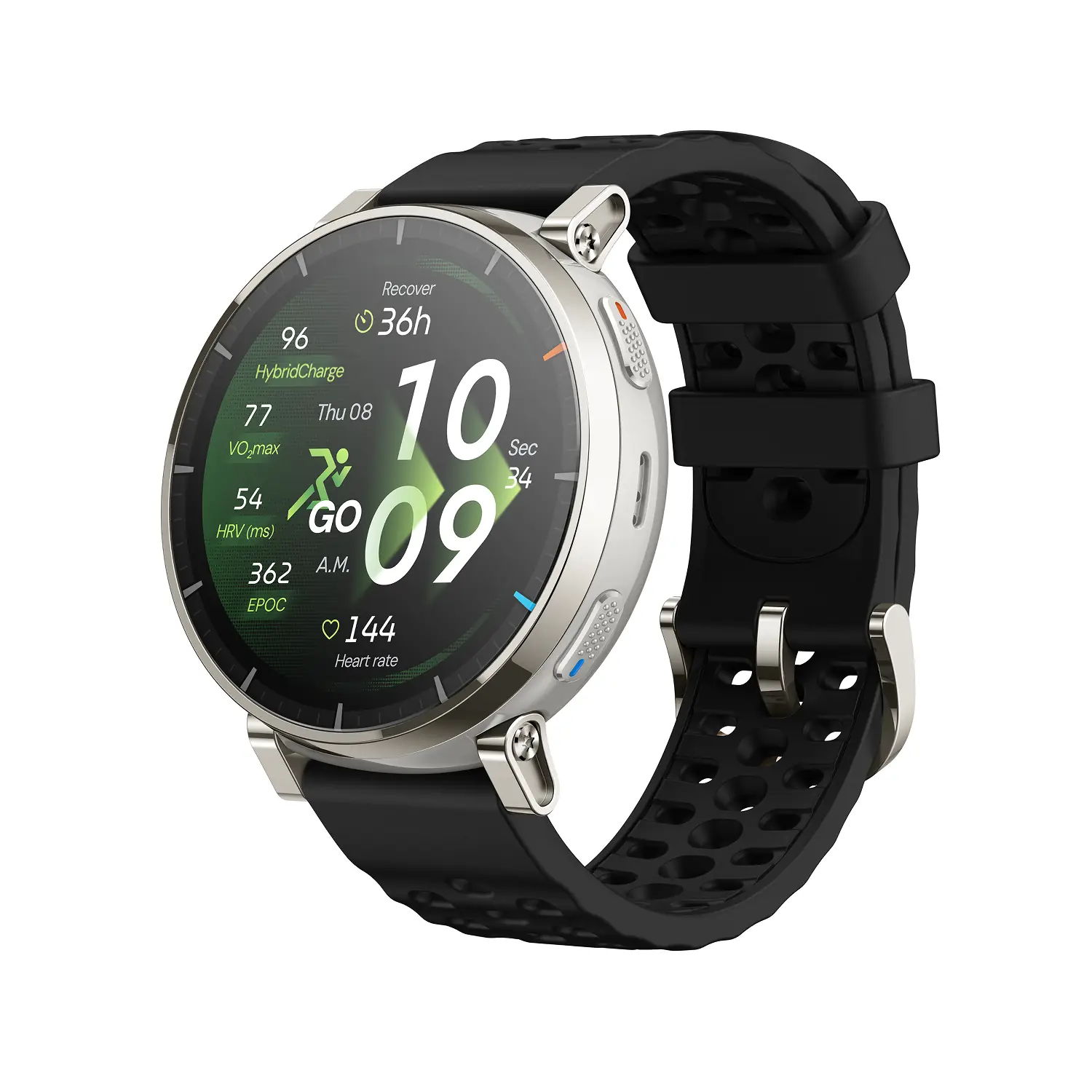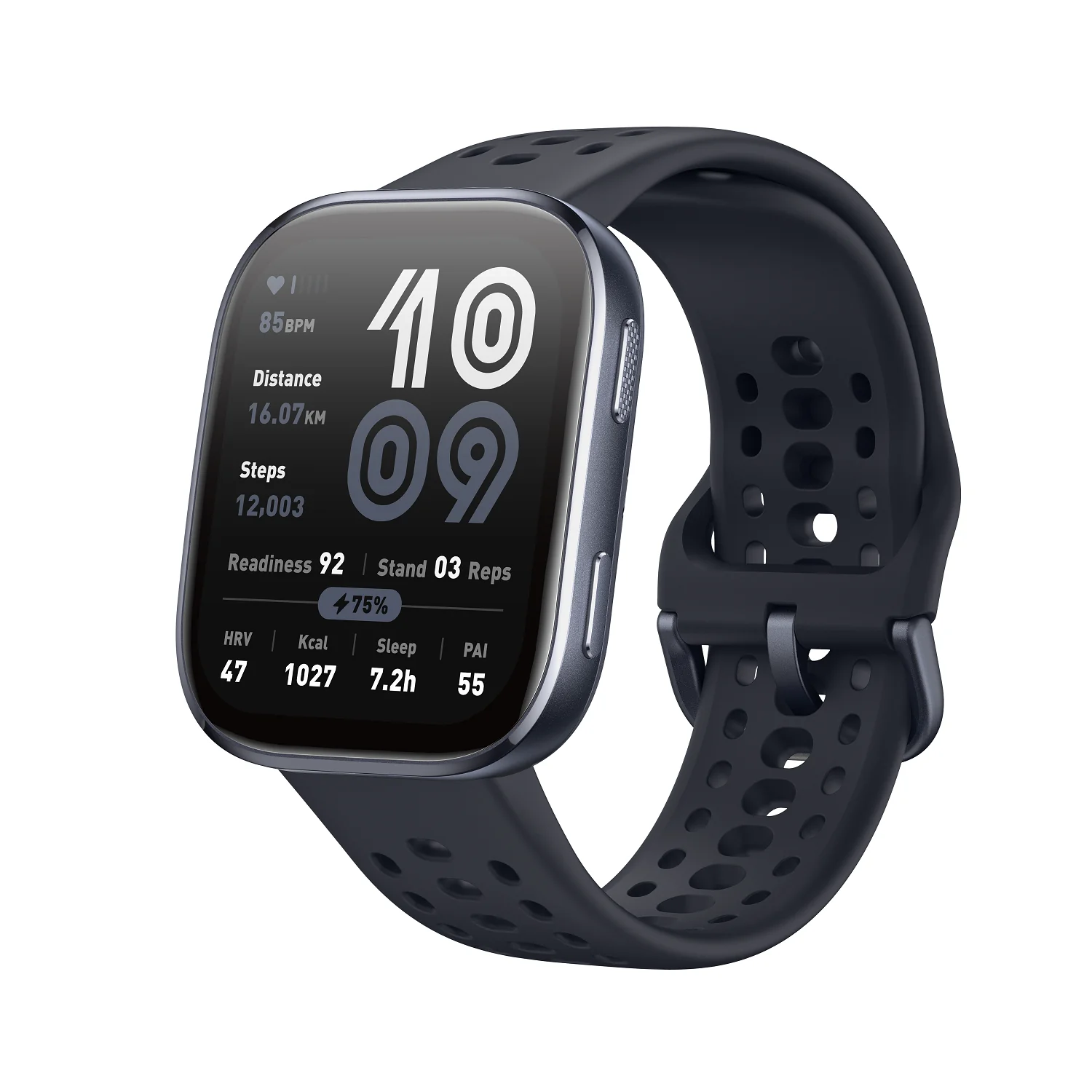
Amazfit Bip 6 46mm
By Amazfit · Smartwatches · Phones & Computers
- 44mm case
- 1.97-inch AMOLED display (390x450)
- Up to 14 days battery life (8 days tested)
- Works with Android and iOS
- GPS with dual-band support
Lowest price seen
~$80.00 (approx.)
from $80.00 at Amazon
- Amazon ~$80.00 (approx.)View at Amazon
- AmazfitView at Amazfit
- eBay (used) eBay: used, open-box, refurbishedView at eBay (used)
- eBayView at eBay
- NeweggView at Newegg
Prices are snapshots. Check the current price with the store.
Summary
A square-case budget smartwatch with a 1.97-inch AMOLED display, built-in GPS, Bluetooth calling and a 340 mAh battery rated for two weeks of typical use. Check the software tradeoffs before buying: the UI lags, the Flow assistant is unreliable, and the best sleep analysis needs a paid subscription.
Strengths
- Battery life that survives real use: 8 days with heavy GPS use, about 10 days regular, 253 hours in Consumer Reports’ lab.
- Heart rate on par with a Polar chest strap in CNET’s testing, within 2–3 BPM of rival wrist trackers in Wareable’s.
- A 1.97-inch AMOLED display at up to 2,000 nits that owners repeatedly praise.
- Bluetooth calling, free offline maps with turn-by-turn navigation and 140+ sports modes.
- Works with Android 7.0+ and iOS 14.0+ and syncs to Strava, Apple Health and others.
- Sub-$80 pricing with a 1-year warranty.
Weaknesses
- The UI lags and navigation feels unintuitive, and the Zepp app has grown cluttered after recent updates.
- GPS is single-band and underreported distance in Wareable’s side-by-side test.
- Bluetooth range is short — calls cut out a room or one floor away — and iPhone users can’t reply to texts at all.
- No NFC payments, no onboard music storage and no skin-temperature sensor.
- The Flow AI assistant failed to open apps when asked in Wareable’s testing.
- Advanced sleep analysis and AI coaching sit behind a $60/year subscription.
Verified specifications
| Model | Amazfit Bip 6, released March 2025, running Zepp OS. |
|---|---|
| Dimensions | 46.3 × 40.2 × 10.45 mm without the sensor base; 27.9 g without the strap. |
| Case | aluminum alloy frame, fiber-reinforced polymer body, two customizable buttons. |
| Display | 1.97-inch AMOLED, 390 × 450 pixels, 302 ppi, up to 2,000 nits peak brightness. |
| Battery | 340 mAh; rated up to 14 days typical use, 6 days heavy use, 26 days battery saver, 32 hours continuous GPS. |
| Charging | magnetic head included, no USB-C cable in the box; 119 minutes for a full charge in Consumer Reports’ lab. |
| Water resistance | 5 ATM — 50 m of static water for up to 10 minutes. |
| GPS | built-in GNSS (GPS, Galileo, GLONASS, QZSS, Beidou); single-band in Wareable’s side-by-side testing. |
| Sports | 140+ built-in profiles, auto-detection of 25 exercise types. |
| Health sensors | heart rate, SpO2, stress, sleep stages and breathing; no skin-temperature sensor. |
| Connectivity | Bluetooth 5.2/BLE with calling; no Wi-Fi, no NFC/payments, no onboard music storage per the spec sheets. |
| Compatibility | Android 7.0+ and iOS 14.0+; syncs to Strava, Apple Health and others. |
| Strap | 22 mm liquid silicone, quick release. |
| Warranty | 12 months US limited, tied to purchases from Amazfit’s official US store. |
Full research notes and sources
Battery life and charging
Amazfit rates the 340 mAh battery at 14 days of typical use, 6 days heavy, 26 days in battery saver and 32 hours of continuous GPS. Testing lands lower: CNET got 8 days with GPS workouts and heart-rate tracking on, Wareable about 10 days with regular use, and Consumer Reports’ lab measured 253 hours — about 10.5 days — with a full charge in 119 minutes. A 30-minute GPS session drained 6% in Wareable’s test. There is no fast charging, and no USB-C cable in the box: the magnetic charging head needs a cable you supply yourself.
GPS and fitness tracking
The watch carries built-in GNSS — GPS, Galileo, GLONASS, QZSS and Beidou — plus free offline maps with turn-by-turn navigation. Wareable’s side-by-side test against a dual-frequency watch found single-band operation: it underreported distance and veered off course. Heart rate is the stronger story. CNET found it on par with a Polar chest strap, Wareable measured resting HR within 2–3 BPM of other wrist trackers most days, and Consumer Reports rates its BPM, pulse-ox and heart-rate measurements excellent and accurate. Pool-swim tracking matched two other trackers, and 25 exercise types auto-detect among the 140+ profiles. Offline maps are free but must be synced in sections because of limited storage — one owner measured about 3 GB total with 445 MB free. Tom’s Guide notes the case can knock against your wrist during runs.
App, assistant and sleep tracking
Zepp OS runs through the Zepp app, which Wareable found cluttered after recent updates, and the UI itself lags with a billboard-style overflow animation. Flow, the AI assistant, is unreliable — Wareable called it “a work in progress” after it failed to open apps when asked. Text replies with the keyboard or dictation work on Android only; iPhone users cannot reply at all. Sleep tracking splits reviewers: Tom’s Guide called it incredibly accurate, while CNET found it credited about an extra hour on weekend nights while the reviewer was awake, and Wareable found it slow to register onset and its readiness scores overly positive. Advanced sleep analysis and AI coaching require Zepp Aura at $60 a year (normally $150). One owner in r/amazfit reports being “extremely disappointed” with the integration between watch and app.
Is it worth it?
At its $79 MSRP — launched in March 2025 at $79, $10 below the Bip 5’s $89 launch price — the Bip 6 is one of the strongest budget smartwatches sold in the US. Best Buy lists it at $80, Macy’s at $85.95, and Consumer Reports’ retailer listed it at $69.99 in October 2026. The ongoing costs are a Zepp Aura subscription at $60 a year (normally $150) for the advanced sleep analysis and AI coaching, plus a USB-C cable you must buy separately. Owners in r/amazfit call the battery “exemplary” after almost two months and say the value punches above its weight class; the same threads show the longest real-world experience covers about two months, so long-term reliability is unknown. Above $100 the math gets harder — watches with payments, music storage and stronger ecosystems cost little more.
Which model this is
This page covers the standard Amazfit Bip 6 — aluminum frame, fiber-reinforced polymer case, 22 mm silicone strap — sold in the US in Black, Charcoal, Stone and Red. Amazfit also sells a premium Black Leather version (43.9 × 43.9 × 9.9 mm, 31.65 g, stainless steel bezel, leather quick-release strap) and the older Bip 5 with a 1.91-inch TFT display. The US listing for the black standard version is ASIN B0DYJKTHYF. One labeling quirk: Amazfit and Wareable call the case 46mm while T3 and CNET list 44mm for the same 46.3 × 40.2 × 10.45 mm body.
Sources
Manufacturer:
- Amazfit Bip 6 user manual (PDF)
- Amazfit Bip 6 — official product page
- Amazfit Bip 6 — US store
- Amazfit US warranty & return policy
- Bip 6 store FAQ (Amazfit Brazil)
- Amazfit support FAQ — dimensions and weight
Independent reviews:
- CNET: I Tested the Amazfit Bip 6
- Wareable review
- Tom’s Guide review
- Android Authority review
- T3 review
- TechRadar review
- Consumer Reports review
- The Telegraph review
- Gadgets & Wearables spec check
Owner reports: